Emotional Intelligence at Work: What It Is, Why It Matters, and How to Build It
AI Generated
Last Updated on October 22, 2026 by Rishi
You can have the sharpest strategy in the room and still lose the meeting. A curt reply on Slack, a teammate who goes silent after feedback, a manager who reacts first and thinks later: small moments like these quietly decide whether a team collaborates or just coexists.
That gap is exactly what emotional intelligence at work addresses. Technical ability gets you in the door, but the capacity to read, manage, and respond to emotions often decides how far you go once you are inside. The timing matters, too. Hybrid schedules, AI tools, and constant change have made human skills harder to practise and harder to replace. The World Economic Forum’s Future of Jobs Report 2025 lists empathy and active listening among the skills that at least half of surveyed employers call essential.
In this guide, you will learn what EQ actually means, which emotional intelligence skills matter most, seven practical ways to improve emotional intelligence, and how managers can build it across a team.
What Is Emotional Intelligence at Work?
Emotional intelligence (EQ) is the ability to recognise and manage your own emotions while understanding and influencing the emotions of others. At work, it shows up in ordinary situations: how you take criticism, how you handle a missed deadline, how you disagree in a meeting, and how you support a stressed colleague.
Researchers Peter Salovey and John Mayer introduced the concept in 1990. Psychologist Daniel Goleman then brought it to a mainstream business audience through his 1995 book, Emotional Intelligence, arguing that top leaders pair technical skill and IQ with a high degree of EQ. Free, practical overviews such as HelpGuide’s guide to EQ at work describe a closely related four-part version: self-awareness, self-management, social awareness, and relationship management.
The Five Components of Workplace Emotional Intelligence
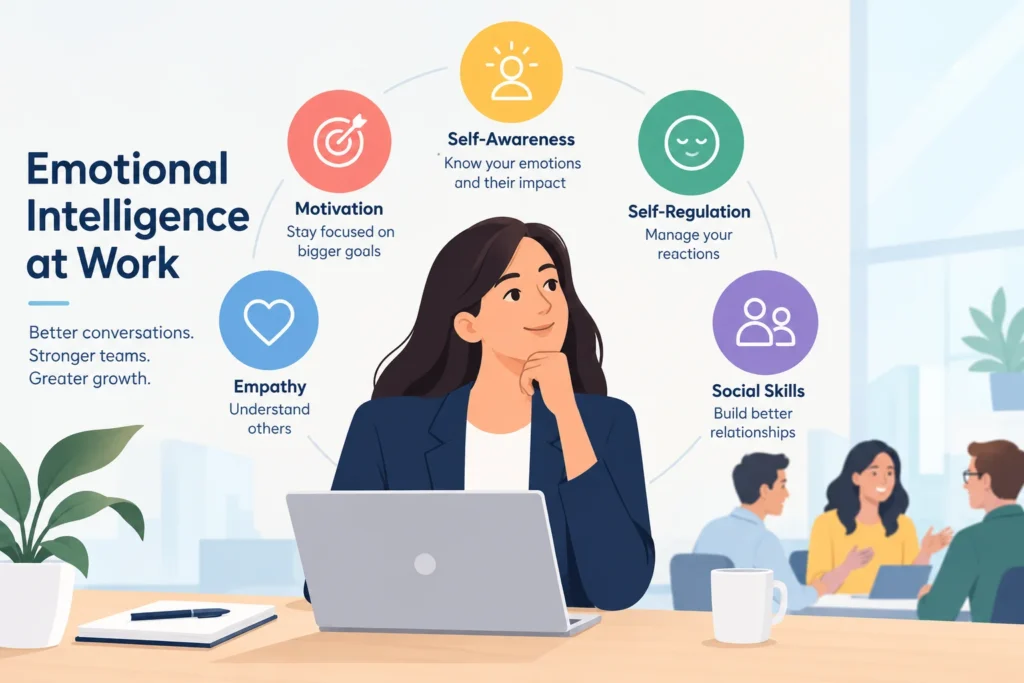
Goleman’s original model breaks EQ into five parts. Think of them as a set of habits you can practise, not personality labels.
| Component | What it means | What it looks like at work |
| Self-awareness | Knowing your moods, triggers, and impact on others | You notice you are getting defensive during a review and say so calmly |
| Self-regulation | Controlling impulsive reactions | You wait before replying to a frustrating email |
| Motivation | Pursuing goals for deeper reasons than pay or status | You keep going after a failed pitch and look for what to fix |
| Empathy | Understanding what others are feeling | You spot that a quiet teammate is overloaded and offer help |
| Social skills | Building rapport and managing relationships | You resolve a disagreement by finding common ground |
EQ vs IQ: Partners, Not Rivals
IQ and technical expertise still matter. Nobody wants an accountant who cannot read a balance sheet. But once people reach a similar skill level, the differences between them tend to come from how they communicate, handle pressure, and work with others. A Preply survey covered by HR Morning found that 73% of respondents considered EQ more important than IQ. That figure reflects opinion rather than proof, but it shows where workers’ expectations are heading.
Why Emotional Intelligence at Work Matters Right Now
Three pressures are pushing workplace emotional intelligence from “nice to have” to everyday necessity.
- Employers are asking for it. The Future of Jobs Report 2025 draws on over 1,000 employers covering more than 14 million workers across 55 economies. Resilience, flexibility, and agility ranked second, cited as essential by 67% of employers. Motivation and self-awareness, along with empathy and active listening, were each named essential by at least half.
- Employees notice the gap. In the Preply survey, 79% agreed that EQ has become more important at work in recent years, and about half said their bosses lacked it.
- Work is harder to read. Hybrid work strips out the hallway conversations and body language that once signalled how people felt. Tone gets lost in text, and burnout can hide behind a green “active” status.
The practical payoff is easy to picture: fewer avoidable conflicts, feedback that actually lands, stronger psychological safety (the sense that you can speak up without being punished), and clients who feel heard. These are everyday outcomes, not abstract ideals.
Emotional Intelligence Skills in Action: Low vs High EQ
Abstract definitions only go so far. This comparison shows how emotional intelligence skills change the outcome of common workplace moments.
| Situation | Low-EQ response | High-EQ response |
| Receiving tough feedback | Argues, explains, or sulks | Listens fully, asks for an example, thanks the giver |
| A project slips | Blames a teammate in the group chat | Names the problem, owns their part, proposes a fix |
| A colleague seems withdrawn | Ignores it as “not my business” | Checks in privately and asks what would help |
| Disagreement in a meeting | Talks over others to win | Restates the other view, then explains their own |
| A manager announces a change | Complains afterwards in private | Asks clarifying questions and raises concerns constructively |
7 Practical Ways to Improve Emotional Intelligence
The encouraging news is that EQ can be developed. Goleman himself argued it can be learned, and the habits below are small enough to start this week.
1. Name the Emotion Before You Act
Vague feelings drive snap reactions. Put a precise word on it: “I’m frustrated,” “I feel overlooked,” “I’m anxious about the deadline.” Naming the emotion creates a small gap between feeling and behaviour, and that gap is where self-awareness begins.
2. Build a Pause Into Your Reactions
Self-regulation is not about suppressing feelings. It is about choosing your timing. Take one slow breath before answering a heated message, or draft the reply and wait ten minutes before sending. Most regrettable workplace moments happen in the first reaction, not the second.
3. Ask for Honest Feedback
Self-assessment tools are a useful start, but they have blind spots because we judge ourselves by intentions while others judge us by impact. Ask two trusted colleagues: “What is one thing I do that helps the team, and one thing that makes work harder?” Then listen without defending.
4. Practise Active Listening
Put the phone down, hold back your next point, and paraphrase what you heard: “So the main concern is the timeline, not the budget. Is that right?” This single habit strengthens empathy, prevents misunderstandings, and makes people feel valued.
5. Swap Assumptions for Questions
When a colleague misses a deadline, the quick story is “they don’t care.” A better move is curiosity: “What got in the way?” Often the real answer, such as unclear priorities or a family emergency, changes your response completely.
6. Track Your Stress Triggers
For two weeks, jot down moments when you felt irritated or drained: who was involved, what happened, and how you responded. Patterns appear quickly. Maybe back-to-back meetings or vague requests set you off. Once you know the trigger, you can plan around it.
7. Give Specific Appreciation
“Great job” fades fast. “The way you simplified that client report saved us a revision round” sticks. The HR Morning coverage of the Preply study notes that many employees simply want their work acknowledged, so specific recognition is one of the cheapest, most effective EQ habits.
Building Emotional Intelligence Across Teams
Leaders Set the Emotional Tone
Teams copy their manager’s reactions. If a leader responds to bad news with calm questions, people bring problems early. If the response is blame, problems go underground. Leaders can model EQ by admitting mistakes, asking for input before deciding, and checking in on workload, not just output.
Make Remote and Hybrid Teams Emotionally Visible
- Open meetings with a quick, genuine check-in rather than jumping straight to tasks.
- Agree on tone norms for chat, such as when to switch from text to a call.
- Hold regular one-to-ones where the first question is about the person, not the project.
Train With Practice, Not Just Theory
Lectures rarely change behaviour. Programmes that blend learning with role-plays and scenario-based exercises tend to transfer better to real situations. Try practising difficult conversations, such as delivering critical feedback or declining a request, in low-stakes team sessions.
Hire and Promote With EQ in Mind
Add behavioural questions to interviews: “Tell me about a time you disagreed with a colleague. What happened next?” Listen for ownership, curiosity about the other person, and how they handled their own emotions.
Common Misconceptions About Emotional Intelligence
- “EQ means being nice all the time.” It does not. High-EQ people can deliver hard messages; they simply do it with timing and care.
- “You’re either born with it or you’re not.” Genetics and upbringing play a role, but the skills can be strengthened with practice.
- “A test score tells the full story.” Measurement is still debated, and self-reported tests are imperfect. Treat scores as conversation starters, and pair them with feedback from the people you work with.
- “Emotions don’t belong at work.” People cannot switch feelings off at the office door. Learning to work with emotions is more professional than pretending they are absent.
Conclusion: Small Habits, Big Workplace Impact
Emotional intelligence at work is not about being soft. It is about noticing what is happening inside you and around you, then choosing a response that moves the work forward. The five components, self-awareness, self-regulation, motivation, empathy, and social skills, each translate into habits you can practise.
Start small. This week, name one emotion before reacting, paraphrase one colleague’s concern before answering, and give one piece of specific appreciation. If you lead a team, add one honest check-in to your next one-to-one. These tiny moves compound, and your colleagues will feel the difference long before any scorecard shows it. Which emotional intelligence skill will you practise first?
Frequently Asked Questions
What is emotional intelligence at work?
It is the ability to recognise and manage your own emotions and respond well to the emotions of colleagues, managers, and clients. It covers how you communicate, handle stress, take feedback, and resolve conflict.
What are the main emotional intelligence skills?
Following Goleman’s framework: self-awareness, self-regulation, motivation, empathy, and social skills. Active listening and constructive feedback are everyday ways these skills show up.
Can you improve emotional intelligence as an adult?
Yes. EQ is widely treated as a learnable skill. Consistent habits such as pausing before reacting, asking for feedback, and practising active listening build it over time.
How long does it take to improve emotional intelligence?
There is no fixed timeline. Small changes in your reactions can appear within weeks, but lasting change comes from months of regular practice and honest feedback.
Is emotional intelligence more important than IQ?
Not in every case, and the two work together. Many workers believe EQ matters more, as the Preply survey shows, but strong results usually need both skill and the ability to collaborate.
How can managers promote workplace emotional intelligence?
Model calm reactions, ask for input, run regular one-to-ones, recognise good work specifically, and use role-play based training. Include behavioural EQ questions when hiring.
How do you show emotional intelligence in remote work?
Check in before diving into tasks, clarify tone in written messages, use video for sensitive topics, and pay attention to changes in someone’s response time or participation.
Can emotional intelligence be measured?
Yes, through self-assessments, 360-degree feedback, and behavioural interviews, though none is perfect. Combining several methods gives a more reliable picture than any single test.
Related Article:
How to Improve Communication Skills for Career Growth
How Team Building Exercises Improve Workplace Collaboration
How to Create a Positive Workplace

Rishi Pundir is an entrepreneur and author who enjoys exploring the latest business and technology trends, news, and insights across the web. He graduated in computer science and has years of experience in digital marketing. He is also passionate about writing in-depth articles on business, emerging technologies, innovations, digital marketing, and strategies for online business growth. He is the main editor of Trending Business Tips.