How Computer Science Graduates Can Build a Successful Career in the AI Era
AI Generated
Last Updated on November 11, 2026 by Rishi
You finish your degree, open LinkedIn, and see three headlines back to back: “AI will replace coders,” “AI engineers are the new rock stars,” and “entry-level tech hiring is frozen.” No wonder so many graduates feel stuck between excitement and panic.
Here is the reality. Computer science is still a strong bet, but a computer science career in the AI era plays by different rules. The U.S. Bureau of Labor Statistics projects software developer jobs to grow 15% between 2024 and 2034, yet employers now expect new hires to ship faster, verify AI output and specialise early. In India, overall tech demand is climbing while generic fresher roles shrink.
This guide shows where the computer science career opportunities really are, which AI skills for computer science graduates deserve your time first, how to build a programming portfolio that earns interviews, and a 12-month plan you can start today.
What a Computer Science Career in AI Era Really Looks Like
The data says demand is shifting, not disappearing
Start with the big picture. The World Economic Forum’s Future of Jobs Report 2025 expects 170 million new jobs worldwide by 2030 against 92 million displaced, a net gain of 78 million. AI and big data top its list of fastest-growing skills, followed by networks and cybersecurity, and technological literacy. The fastest-growing roles include big data specialists, fintech engineers, and AI and machine learning specialists.
The BLS adds useful detail. Software developers, QA analysts and testers are projected to grow 15% over 2024–34. Its 2026 analysis of AI and employment projects data scientists to grow 33.5%, and information security analysts to grow at least 19%. Meanwhile, computer programmer jobs, the narrower role of turning instructions into code, are projected to fall 6%. In short, typing code is being automated; engineering judgment is not.
The honest part: entry-level hiring is tougher
A Stanford Digital Economy Lab study, “Canaries in the Coal Mine?“, analysed ADP payroll data covering millions of U.S. workers through June 2026. Its August 2026 update found that employment of 22–25-year-olds in AI-exposed occupations, software development included, is 19% below where it would be had it kept pace with less-exposed peers. That gap was 15% on the same measure in July 2025.
India shows a similar split. NASSCOM estimates the tech workforce grew by about 1.35 lakh to roughly 5.9 million in 2026, and analysts quoted by HFS Research expect fewer generic delivery roles but stronger demand for AI literacy, data engineering and cybersecurity. TeamLease EdTech’s first-half 2026 outlook likewise points to skills-first hiring over degree-based screening.
The takeaway: the bar for a first job has moved up, and you can clear it with targeted skills and visible proof of work.
Computer Science Career Opportunities Worth Targeting
You don’t need to chase every trend. These six paths for a computer science career in the AI era line up with employer demand and the BLS and WEF data above.
| Role | What you’ll do | Skills to build |
| AI / ML Engineer | Build, fine-tune and deploy machine learning and deep learning models | Python, PyTorch, statistics, MLOps |
| AI Engineer (LLM apps) | Build products on Large Language Models using APIs, RAG and agents | Prompt design, vector databases, evaluation |
| Data Scientist / Data Engineer | Turn raw data into pipelines, dashboards and predictions | SQL, Python, Spark, data modelling |
| Cloud Engineer | Run scalable, secure infrastructure for apps and models | AWS/Azure/GCP, Kubernetes, Terraform |
| Cybersecurity Analyst | Defend systems, including against AI-enabled attacks | Networking, threat modelling, SOC tools |
| Full-Stack Developer (AI-ready) | Ship web products with AI features built in | React, Node or Python, APIs, testing |
Not sure where to start? Pick the path where your curiosity and your projects already overlap, then go deep.
AI Skills for Computer Science Graduates: What to Learn First
Sharpen the fundamentals AI can’t fake
Future-proof technology skills start with strong foundations, which still separate engineers from prompt-pasters. Revisit data structures and algorithms, operating systems, databases and networking, plus enough probability and linear algebra to understand why models behave the way they do. Above all, build problem-solving skills: breaking a vague request into small, testable pieces. AI can write a function, but it can’t tell you whether it’s the right one.
Learn to build with large language models
Using ChatGPT is not a skill. Building reliable products on top of Large Language Models is. Start here:
- Python and API integration for calling LLMs
- Retrieval-augmented generation (RAG) and vector databases to ground answers in real data
- Evaluation: test sets, hallucination checks and cost-latency trade-offs
- Core machine learning, deep learning and natural language processing concepts
- Basic MLOps: versioning, monitoring and deployment
Use AI-assisted coding, but verify everything
Generative AI tools are now standard equipment. Stack Overflow’s 2025 Developer Survey, covering 49,000+ developers in 177 countries, found that 84% use or plan to use AI tools and 51% of professionals use them daily. Yet 46% distrust the accuracy of AI output versus 33% who trust it, and about two-thirds say AI answers are close but subtly wrong.
That gap is your opportunity. Employers want graduates who can review, test and debug generated code. Build one habit: before accepting any AI suggestion, write a test for it, explain it in your own words, and check one edge case.
Add one specialisation on top of your foundation
Be a generalist with one deep spike. Good options are cloud engineering, cybersecurity, data science or AI engineering. A graduate who can secure and deploy a small ML service stands out more than someone who “knows a bit of everything.”
Build a Programming Portfolio and GitHub Projects That Prove You Can Ship
Recruiters skim hundreds of near-identical résumés. A programming portfolio with three solid projects beats ten tutorial clones. What makes GitHub projects convincing?
- A real problem: a timetable assistant for your college, a Hindi-English support bot, an invoice parser for small shops
- A live demo link, not just code
- A clear README covering the problem, architecture, trade-offs and what you’d improve
- Tests, plus an evaluation section for any AI feature
- Commit history that shows steady progress
Three starter ideas: a RAG-based Q&A bot over public documents with a small evaluation set; a churn or fraud prediction model with an explainability dashboard; and a full-stack app deployed to the cloud with CI/CD and monitoring. Add a short write-up on what broke and how you fixed it. Honest post-mortems signal maturity.
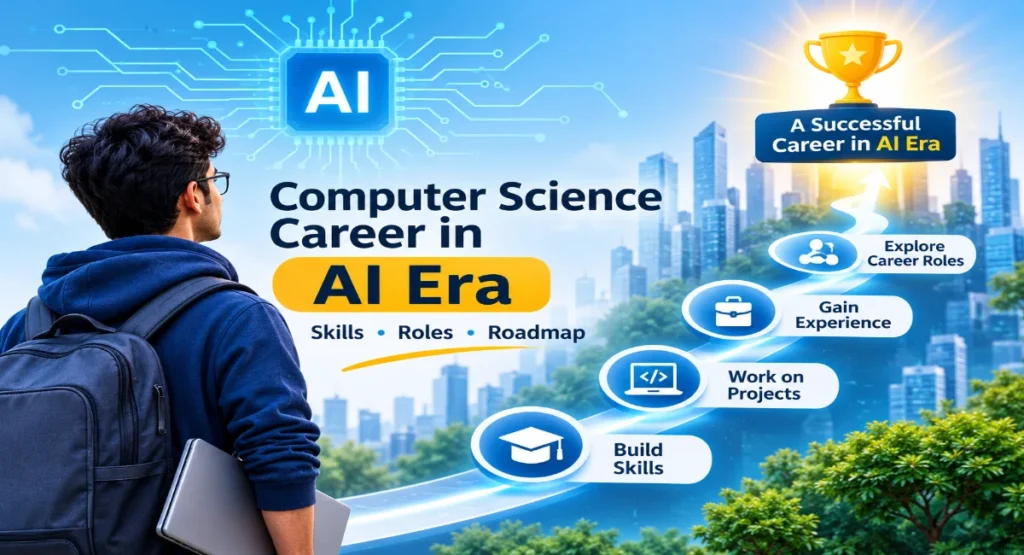
Computer Science Career Tips: A 12-Month Roadmap
- Months 1–3, foundations: Python, SQL, Git and a refresher on data structures and algorithms. Ship one small project.
- Months 4–6, build with AI: create an LLM app with RAG, deploy it, and learn one cloud platform.
- Months 7–9, specialise: build a second project in your chosen area and contribute to an open-source repository.
- Months 10–12, get seen: write about your projects, ask for referrals, join hackathons, apply for internships and run mock interviews.
Two more computer science career tips: network before you need to, because referrals can open doors that cold applications don’t; and practise explaining technical work in plain language. Communication drives career growth as much as code does.
How Technical Interviews Are Changing
Expect fewer memorisation puzzles and more questions about how you think. Be ready for:
- System design basics: APIs, databases and simple scaling decisions
- Debugging or reviewing unfamiliar code, including AI-generated code
- Explaining the trade-offs behind your own projects
- Discussing how you use AI tools responsibly
If you can’t explain a line of code, you don’t own it yet.
The Future of Computer Science Jobs: Trends to Watch
- Agentic AI: AI agents that plan and act are still early. Stack Overflow found only about 31% of developers use them, so engineers who add guardrails, testing and monitoring will be valuable.
- AI security and responsible AI: cybersecurity ranks right behind AI and big data on the WEF skills list, and AI adds new attack surfaces and governance questions.
- Domain expertise: fintech, healthcare and logistics need engineers who understand the business, not just the stack.
- Continuous learning: the WEF reports that workers can expect about 39% of their current skills to change or become outdated by 2030. Treat learning as part of the job.
Common Mistakes That Slow Down a Computer Science Career in the AI Era
- Tutorial hopping with nothing shipped
- Pasting AI-generated code you can’t explain
- Collecting certificates without projects to back them up
- Waiting until you feel “ready” before applying
Conclusion: Your Next Step
A computer science career in the AI era rewards people who combine strong fundamentals with practical AI skills and visible proof of work. The market is shifting, not closing. The future of computer science jobs favours engineers who can build, secure and verify intelligent systems, while generic entry-level roles are under pressure.
Frequently Asked Questions
Is a computer science career in the AI era still worth it?
Yes, for people who adapt. The BLS projects 15% growth for software developers through 2034, and the WEF lists tech roles among the fastest-growing jobs. Entry is more competitive, so skills and projects matter more than ever.
Will AI replace software engineers?
AI is automating routine coding tasks, not the whole job. Engineering still involves requirements, design, security, testing and accountability. Stanford’s data suggests the pressure is highest on junior roles built around automatable tasks, so build skills that work alongside AI.
Which AI skills should computer science graduates learn first?
Python, core machine learning concepts, LLM APIs, RAG basics, cloud deployment and code verification, backed by strong fundamentals.
Do I need a master’s degree for a career in AI?
Not always. Research roles often prefer advanced degrees, but many applied AI engineering roles reward fundamentals, projects and internships.
How many GitHub projects do I need?
Three or four well-documented, deployed projects are enough. Quality and clarity beat volume.
What are the best career options for CS freshers in India?
AI and data roles, cloud engineering, cybersecurity and full-stack development keep coming up in hiring reports, with global capability centres driving much of the new demand. Skills-first screening means proof of work counts.
How do I prepare for technical interviews in the AI era?
Practise data structures and algorithms, learn system design basics, and rehearse explaining your own projects. Be ready to review and debug AI-generated code.
Related Articles:
Why Every Professional Needs a Strong LinkedIn Profile
How to Negotiate Salary
How to Write a Cover Letter for Job Application
How to Improve Communication Skills for Career Growth
How to Write a Resume

Rishi Pundir is an entrepreneur and author who enjoys exploring the latest business and technology trends, news, and insights across the web. He graduated in computer science and has years of experience in digital marketing. He is also passionate about writing in-depth articles on business, emerging technologies, innovations, digital marketing, and strategies for online business growth. He is the main editor of Trending Business Tips.