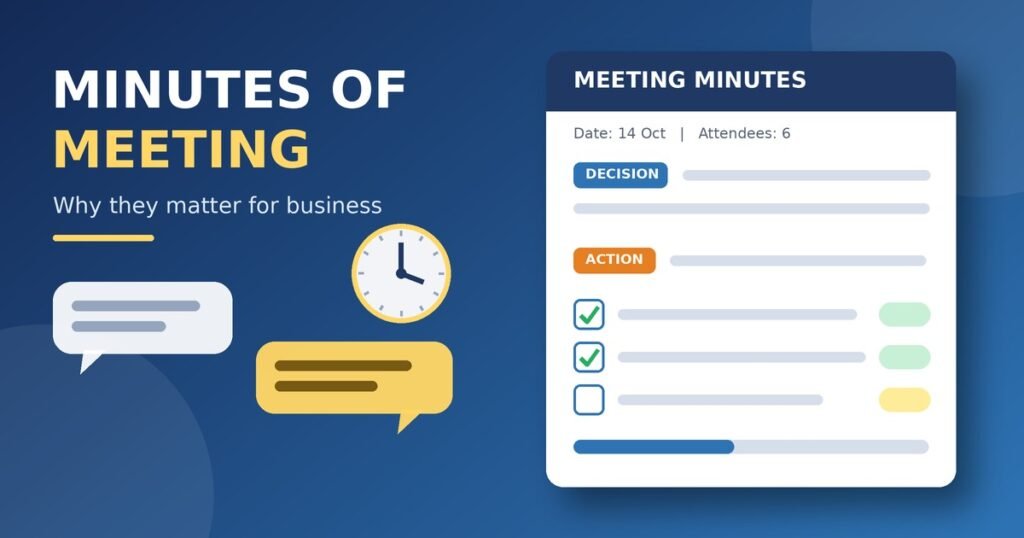
Why Are Minutes of Meeting Important for Businesses?
AI Generated
Last Updated on September 29, 2026 by Rishi
Picture this: your team spends an hour agreeing on a launch date, a budget and who owns what. Two weeks later, three people remember three different versions of that conversation. Sound familiar?
That gap is exactly why minutes of meeting matter. Laxis’s State of Meetings 2026 report puts the average knowledge worker at roughly 21.7 meetings a week, about 11 hours or 28% of the workweek. The same report estimates that 70% of decisions are forgotten within 24 hours when nobody shares follow-up notes. Add hybrid work, cross-time-zone calls and AI note-takers, and a clear written record is more useful than ever.
In this guide, you’ll learn what are meeting minutes, why they matter, how to write meeting minutes step by step, a format you can copy, mistakes to avoid, and where AI fits in.
What Are Meeting Minutes? A Plain-English Definition
Meeting minutes are the official written record of a meeting: who attended, what was discussed, what was decided, and who must do what next. They are a summary, not a script. Readers need outcomes, not every “um” and side joke.
Minutes vs. Meeting Notes vs. Transcripts
People often mix these up, but each does a different job.
| Personal notes | Meeting minutes | Transcript | |
| Purpose | Helps one person remember | Official shared record | Word-for-word capture |
| Length | Any | Short and structured | Very long |
| Audience | The note-taker | Attendees, absentees, auditors | Reference only |
| Decisions and owners? | Sometimes | Always | Buried in dialogue |
Why Are Minutes of Meeting Important for Businesses?
Minutes look like admin work until the day you need them. Here is where they earn their keep.
They Create One Shared Version of the Truth
Memory is selective. Minutes settle the “I thought we agreed…” debate in seconds, because everyone can point to the same dated document.
They Turn Discussion into Accountability
“We should look into that” rarely gets done. A named owner with a deadline usually does. Compare “Marketing to review landing page” with “Meera to send revised landing page copy to legal by 14 October.” The second version cannot be misread.
They Protect the Business Legally and for Compliance
For many organisations, minutes are mandatory. In India, Section 118 of the Companies Act, 2013 requires companies to keep minutes, and Secretarial Standard SS-1 sets timelines: draft minutes go to directors within 15 days, and final minutes are entered in the minutes book within 30 days, as this Sansa Legal guide to board meeting compliance explains. Signed minutes also act as evidence of what was decided.
Even where no law applies, such as client calls, vendor negotiations or project kick-offs, a dated record helps if a dispute comes up. Rules vary by country and company type, so confirm requirements with your company secretary or legal advisor.
They Keep Absent Teammates and New Joiners in the Loop
Someone on leave, in another time zone or new to the project can catch up in two minutes instead of booking a recap call.
They Cut Down Repeat Meetings
Good minutes make “Did we already decide this?” a thirty-second search. They also show which topics keep rolling over, a hint that a decision is stuck.
What to Include in Meeting Minutes
Whatever the format, a useful set of minutes covers these basics:
- Meeting title, date, time and location or platform
- Attendees, absentees and their roles
- Purpose or agenda items
- Key discussion points, kept brief
- Decisions made, with vote counts if there was a formal vote
- Action items, each with an owner and a deadline
- Open questions or parked topics
- Next meeting date
Leave out side chatter, personal opinions and long verbatim quotes. Stay neutral and factual, especially for board or client-facing records.
How to Write Meeting Minutes: A 4-Step Process
Step 1: Prepare Before the Meeting
Ask the organiser for the agenda and prepare your outline from it. Pre-fill the date, time and invitee list. Agree with the chairperson on what counts as a “decision,” and test your recording or note-taking tool before people join.
Step 2: Take Notes During the Meeting
Here is how to take meeting minutes without missing the conversation:
- Tick off attendees as they join.
- Record decisions and action items as they happen, not from memory afterwards.
- Use short phrases and tags like DECISION and ACTION, so they are easy to find later.
- Confirm out loud: “Just to check, Arjun owns the vendor shortlist by Friday?”
- Skip the opinions. Capture what was said and agreed.
Step 3: Draft the Minutes Within 24 Hours
This is how to write minutes from a meeting properly: draft them while the discussion is fresh. Expand your shorthand, double-check names, dates, and figures, and separate decisions from discussion. Write in the past tense and stay neutral. For a typical hour-long meeting, one to two pages is a sensible target.
Step 4: Send, Get Approval and File
Send the minutes to attendees and anyone affected, and ask for corrections by a set date, say 48 hours. Then save the approved version in a shared, searchable folder. For board meetings, follow the SS-1 timeline mentioned earlier.
Meeting Minutes Format: A Simple Template You Can Copy
There is no single official format for business meetings, but this layout works for most teams:
| Weekly Product Sync – Meeting Minutes |
| Date: 14 October 2026 | Time: 11:00–11:45 | Platform: Google Meet |
| Present: Meera (chair), Arjun, Kabir | Absent: Sana (on leave) |
| Purpose: Finalise the v2 launch timeline. |
| Discussion: Design is on track. QA flagged two open bugs on checkout. Marketing needs final screenshots by 20 October. |
| Decisions: Launch moves to 5 November. Checkout fixes are the top priority. |
| Next meeting: 21 October, 11:00 |
| Action item | Owner | Due |
| Fix checkout bugs | Kabir | 24 Oct |
| Share final screenshots | Arjun | 20 Oct |
| Update launch plan and notify stakeholders | Meera | 16 Oct |
Vague vs. Useful Wording
| Vague | Useful |
| Discussed budget concerns. | Budget capped at ₹8 lakh; finance to confirm by 18 Oct. |
| Team to look at hiring. | Priya to draft the job description by Friday. |
| Everyone agreed. | Approved 4–1; Kabir dissented on timing. |
Manual vs. AI-Assisted Minutes: Pros and Cons
Laxis reports that about 75% of professionals now use an AI note-taker in meetings. Tools such as Otter.ai, Fireflies and Fathom can transcribe, summarise and pull out action items. The same report cites 95%+ accuracy on clean audio, dropping to roughly 85–90% with crosstalk, accents and jargon.
| Pros | Cons |
| You can join the discussion instead of typing | Names, jargon and acronyms get mangled |
| Fast first draft and searchable archive | Summaries can miss tone, context or sensitive nuance |
| Consistent structure across meetings | Privacy and consent risks, especially with external guests |
My suggestion: let AI produce the first draft, then have a human check every name, number and decision before you send it. Tell participants when a meeting is being recorded. Laxis notes that 73% of businesses cite privacy as their top barrier to adoption.
Common Mistakes to Avoid When Writing Minutes
- Writing everything down instead of decisions and actions
- Leaving action items without an owner or deadline
- Waiting a week to draft, when details have already faded
- Mixing in personal opinions or emotional language
- Skipping the approval step, so errors stay in the record
- Saving files where nobody can find them later
Conclusion
Minutes of meeting are a small habit with a big payoff. They keep decisions from evaporating, give tasks a clear owner, support compliance and let absent colleagues catch up quickly.
To get started, pick a simple template, record decisions and action items live, draft within 24 hours and send the final version for quick approval. Try it for your next three meetings. Your team will likely notice the difference before you do.
FAQs About Meeting Minutes
What are meeting minutes in simple words?
They are a short, official summary of a meeting covering attendance, decisions and next steps.
Why are minutes of meeting important?
They give everyone one reliable record, assign accountability, support compliance and save time on repeat discussions.
How do I take meeting minutes if I am new to it?
Start with the agenda as your outline, note attendees, and focus on decisions and action items. Use short phrases and confirm owners before the meeting ends.
How long should meeting minutes be?
Usually one to two pages. Length depends on the meeting, but they should summarise outcomes rather than repeat the conversation.
Who should write the minutes?
A designated note-taker or secretary, often not the person leading the meeting. Teams can rotate the role so it does not fall on one person.
How soon should minutes be sent out?
For team meetings, within 24 to 48 hours. Board meetings in India follow SS-1, which requires draft circulation within 15 days.
Can AI write meeting minutes?
Yes, as a first draft. Always review it for accuracy and get consent before recording.
Related Article: How to Create a Positive Workplace by Measuring Employee Happiness

Rishi Pundir is an entrepreneur and author who enjoys exploring the latest business and technology trends, news, and insights across the web. He graduated in computer science and has years of experience in digital marketing. He is also passionate about writing in-depth articles on business, emerging technologies, innovations, digital marketing, and strategies for online business growth. He is the main editor of Trending Business Tips.