The Real Cost of a No-show: How Appointment-based Businesses Can Measure and Reduce Lost Revenue
AI Generated
Last Updated on October 29, 2026 by Julia Ching
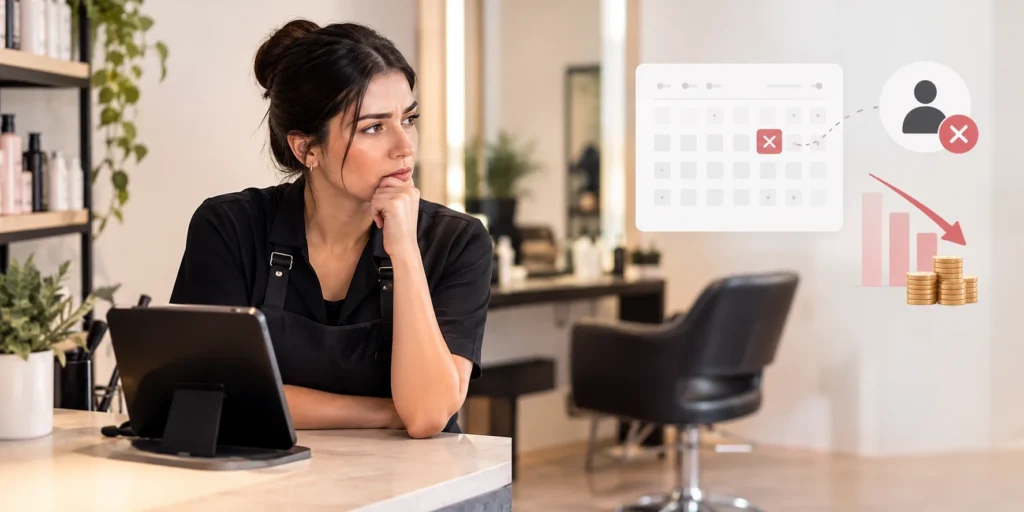
A client books a 3 pm haircut. Then she just doesn’t come. No call and no message.
The chair stays empty for an hour. You still pay your stylist for that hour. And you can’t sell that time to anyone else now.
I talk to salon and spa owners almost every day. Most of them hate no-shows. But very few know how much money they lose to them. So let’s work that out. Then let’s look at easy ways to cut it down.
How often do clients not show up?
It depends on the type of business. Here is what it found.
| Type of business | No-show rate | Typical bill |
| Salons | 2% | $77 |
| Barbershops | 4% | $34 |
| Nail studios | 4% | $73 |
| Medical spas | 4% | $216 |
2% or 4% sounds small. It isn’t small when your diary is full every day.
The report also found something odd about nail studios. Their cancellations went down from 16% to 11% in one year. But their no-shows went up from 1% to 4% in the same year. So fewer cancellations don’t always mean more people in the chair.
What one empty slot costs you
The math here is easy. You only need three numbers.
Money lost each month = Bookings per month × No-show rate × Average bill
Let’s try it. Say your salon gets 600 bookings a month. Your no-show rate is 4%. Your average bill is $77.
That’s 24 missed visits a month. 24 visits at $77 each is $1,848. Over a full year you lose $22,176.
That’s just the money from the service itself. The real loss is bigger.
The costs you don’t see right away
Here is what else you lose when someone doesn’t turn up.
- Staff pay. Your team gets paid even when the chair is empty.
- Extra sales. No visit means no shampoo or add-on sold either.
- Other clients. Someone else wanted that time. They may have gone to another salon.
- Wasted products. Maybe the color was mixed already. Maybe the room was set up.
- Future visits. Some clients feel bad after missing a visit. So they never book again.
One more tip. Count no-shows and late cancellations as two different things. They have different causes. So they need different fixes.
How to work out your own number
1. Get your booking data
Look back at the last three months of bookings. Count how many people didn’t show up.
2. Find your no-show rate
Divide your no-shows by your total bookings. Multiply that by 100. Now you have your rate.
3. Find your average bill
Take the average amount a client pays per visit. Add extras if most clients buy them.
4. Look for patterns
Check which days and times have the most no-shows. Then check by service and by staff member. You may spot a pattern. It’s often Monday mornings or first-time clients.
Easy ways to cut no-shows
Send a reminder
This is the simplest fix. It’s also the one with the most research behind it.
A large Cochrane review looked at text reminders for doctor visits. Without a reminder 67.8% of people showed up. With a text reminder, 78.6% showed up. Phone calls worked about the same. But texts cost less.
Send two reminders
A 2018 study in The American Journal of Managed Care tested this at 25 clinics. One group got a reminder three days before. Then they got another one the day before. This worked better than just one reminder.
It helped most with people who often miss visits. In that group 20.5% missed after two reminders. With one reminder it was about 24% to 25%. And people didn’t mind the extra message.
Yes these studies are about doctor visits. But people forget a haircut the same way they forget a checkup.
Make it easy to cancel
A lot of no-shows are people who wanted to cancel. It was just too much effort. Put a cancel or change link in every reminder. Then you can give that time to someone else.
Take a small deposit
People take a booking more seriously when they’ve paid something. Use deposits for long or expensive services. They also work well for new clients. Just make your rule clear when people book.
Keep a waiting list
A waiting list helps you fill gaps fast. When someone cancels you message the next person on the list.
Let software do the boring work
Doing all of this by hand takes a lot of time. Small teams don’t have that time. Good salon booking software can send reminders and take deposits for you. It can also run your waiting list. Pick one that shows your no-show rate too. Then you can see if things are getting better.
Be kind to repeat no-shows
Some clients miss again and again. Talk to them in private and don’t blame them. Life gets busy. A friendly message often fixes it. If it keeps happening then asking for a deposit is fair.
Key takeaways
- A no-show costs more than the price of the service.
- Use three months of data and one easy formula to find your loss.
- Count no-shows and cancellations separately.
- Text reminders help people show up. They also cost less than calls.
- Two reminders work better than one.
- Deposits and waiting lists protect your best time slots.
You don’t have to fix everything at once. Find your number this month. Then start with one change.
Related Articles:
15 Essential Business KPIs Every Small Business Owner Should Track
How SaaS Businesses Can Turn Website Visitors Into Long-Term Customers
How Customer Retention Strategies Can Improve Long-Term Business Value

Julia Ching
Julia Ching is a Marketing Manager at Salonist. She helps salon and spa owners with bookings and keeping clients coming back.