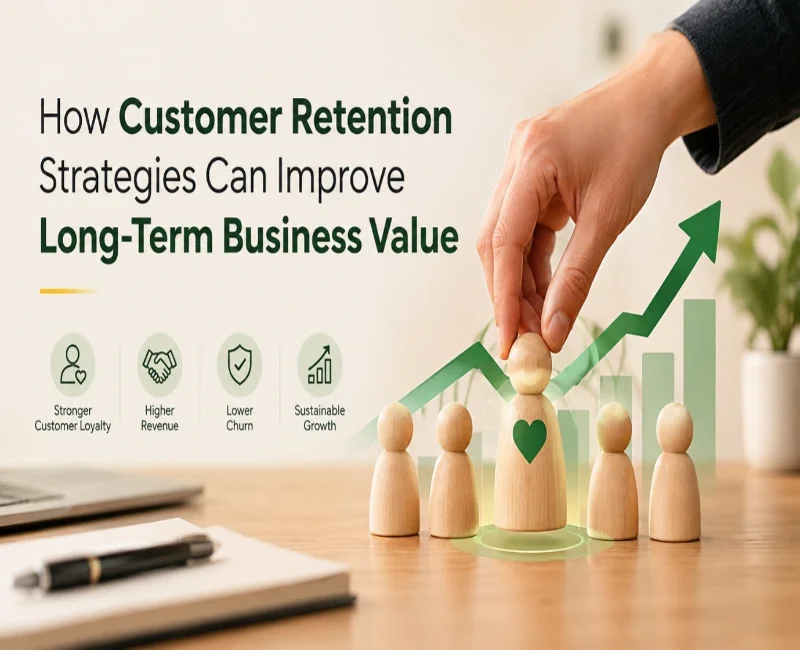
How Customer Retention Strategies Can Improve Long-Term Business Value
AI Generated
Last Updated on September 20, 2026 by Rishi
Customer retention has turned out to be an essential element in defining whether the business will achieve success in the future. Attracting new customers might be important for business growth but retaining customers can provide stability and regular opportunities to earn money. People who were once customers of the business know the goods and services offered by it and have experience in dealing with it so they are expected to come back in the future if the need appears.
It is possible to make retained customers the source of business growth as they might use the product or services many times, leave positive reviews about it, recommend it to friends or workmates. In such a way the loyal audience can become a source of regular revenues for the business. With the help of customer retention, it is possible to obtain information regarding purchasing patterns and preferences that will allow improving the offering made by the business. By concentrating on customer satisfaction, communication, personalization and service quality, businesses can establish good relations with their audiences. Based on the information provided by Consegic Business Intelligence, the worldwide Customer Relationship Management (CRM) market has been evaluated at USD 75.77 billion in 2024 and is forecasted to grow up to USD 188.35 billion in 2032 at a CAGR of 13.5% for the period between 2025 and 2032.
Related Article: 7 Ways CRM Software Helps Small Businesses Grow Faster
Building Strong Customer Relationships Through Personalized Experiences
Personalization can be used extensively to motivate customers to stay in touch with the company. Customer experiences should be tailored in accordance with individual needs, preferences, and purchasing history to increase their willingness to interact with businesses. Responsible usage of customer data can enable companies to recommend suitable products, deliver offers personalized for a specific customer, and communicate through the right channels. In this way, an online retailer will be able to recommend products based on previous transactions made by a customer, whereas a service provider will be able to contact a customer based on his previous interaction.
Nevertheless, personalization does not always rely on automated recommendations. Successful customer relations can be achieved through prompt communication, support, and understanding of customers’ needs. Companies that listen and react accordingly are more likely to build stronger relationships and earn customer loyalty. Consistency of the experience offered to customers on web sites, mobile applications, social networks, and in retail stores can be used as an additional tool for improving relations. Personalized experiences can help businesses to attract customer loyalty and decrease the likelihood of switching brands.
Using Customer Feedback to Improve Products and Services
The opinion of customers helps businesses to know what they like and dislike. Rather than viewing this feedback as just another measurement of customer satisfaction, organizations can see it as a way to develop themselves further. Feedback can be gained from surveys, reviews, social media, customer support and communication with customers directly. Feedback analysis can be used by businesses to recognize recurring issues and understand the changes in expectations of customers.
Using feedback is especially relevant for customer retention strategies. In cases when the organization sees the importance of the customers’ opinion, they will feel appreciated and engaged. In other words, by fixing some of the complaints or making improvements according to customers’ suggestions, a business will demonstrate its willingness to evolve. Companies can even inform customers about the changes which were done after their opinions were taken into account. This will create a continuous feedback loop which will help businesses to get better with every cycle. As a result, by constantly gathering customer feedback and developing on it, organizations can raise the level of customer satisfaction, decrease customer frustration and foster loyalty.
Loyalty Programs and Engagement Strategies That Encourage Repeat Purchases
The implementation of loyalty programs might motivate people to buy products repeatedly through offering extra value that is connected to customers’ interaction with the company. Reward points, discounts, special offers, early access to the goods, members’ privileges, and personalized promotions can become elements of loyalty programs. If properly implemented, loyalty programs might not only encourage customers to return but also motivate companies to communicate regularly with their target audience.
It goes without saying that to succeed in terms of customer engagement, discounts are not enough. Companies can build relationships with their potential clients through sharing valuable information, celebrating the key milestones of each client, introducing new products, and providing something unique. Using digital marketing tools, organizations have an opportunity to communicate with their audience through personalized messages, offers, and recommendations. Gamification can help to make loyalty programs more exciting using points, levels, challenges, and achievement-based rewards.
At any rate, a proper loyalty strategy should benefit customers but not make them feel forced to buy. If customers are provided with some value regularly, they are going to prefer one brand to its competitors. It leads to higher customer lifetime value, stable revenue flow, and sustainable development of a company.
Measuring Customer Retention to Strengthen Long-Term Business Value
Measuring customer retention helps in establishing whether a particular business has the right measures to ensure that its customer loyalty campaigns succeed. A number of metrics can be used for measuring success, such as customer retention rate, repeat purchase rate, customer lifetime value, churn rate, and customer satisfaction. These measures help in understanding customers’ behaviors and determining how to address them.
For example, if the retention rate increases, it means that customers are satisfied with the products or services that a particular company provides. If churn is increasing, it may be an indication of problems with pricing, services offered, product performance or customer support. Companies can use these indicators and feedback received from customers to figure out why customer behaviors have changed. This process will also help in understanding whether loyalty programs and personalization initiatives have been effective enough.
Customer retention should not be seen as a short-term goal since it is a continuous activity. The analysis and measurement of customer retention help businesses in making correct decisions based on certain indicators. Thus, improved retention results in increased revenues, customer lifetime value, reduced pressure on customer acquisition, and business growth.
Conclusion
Retaining the customer base is an important element in ensuring sustainable value for any organization and continuous growth. Organizations that concentrate on personalization, excellent customer service, feedback-based improvements, and successful loyalty programs can enhance customer relationships. These practices not only foster repeat purchase behavior but also improve consumer satisfaction and customer lifetime value. Measuring the rate of retention, churn and customer behavior on regular basis helps the organizations to identify where improvement is needed and make wise decisions. Organizations have to evolve and come up with new retention strategies with changing customer expectations. Concentrating on customers and adding value to their experience helps to generate sustainable value for any business.

Rishi Pundir is an entrepreneur and author who enjoys exploring the latest business and technology trends, news, and insights across the web. He graduated in computer science and has years of experience in digital marketing. He is also passionate about writing in-depth articles on business, emerging technologies, innovations, digital marketing, and strategies for online business growth. He is the main editor of Trending Business Tips.