7 Ways Digital Marketers Can Leverage AI Tools in 2026
AI Generated
Last Updated on July 2, 2026 by Rishi
Artificial Intelligence has moved beyond being an experimental technology. In 2026, it has become an essential part of every successful marketing strategy. Whether you’re running a startup, managing an eCommerce brand, working in SEO, or handling enterprise marketing campaigns, the right AI tool for digital marketing can help you work faster, make smarter decisions, and achieve better results.
The biggest challenge for marketers today isn’t producing more content—it’s producing the right content, targeting the right audience, and continuously optimizing campaigns. Consumers expect personalized experiences across every touchpoint, while marketing teams are under pressure to do more with fewer resources.
In this guide, you’ll learn about the following details:
- How to use AI tools in digital marketing effectively
- Seven practical ways AI improves marketing performance
- Real-world examples
- Common mistakes to avoid
- Future AI trends marketers should prepare for
Why AI Is Transforming Digital Marketing
Traditional digital marketing often involves repetitive manual tasks:
- Writing content
- Keyword research
- Audience segmentation
- Campaign optimization
- Email personalization
- Reporting
- Performance analysis
AI automates many of these processes and helps marketers make better decisions by leveraging predictive analytics and customer insights. Instead of replacing marketers, AI enhances creativity and strategic thinking by eliminating repetitive work.
Top 7 Benefits of AI Tools in Digital Marketing
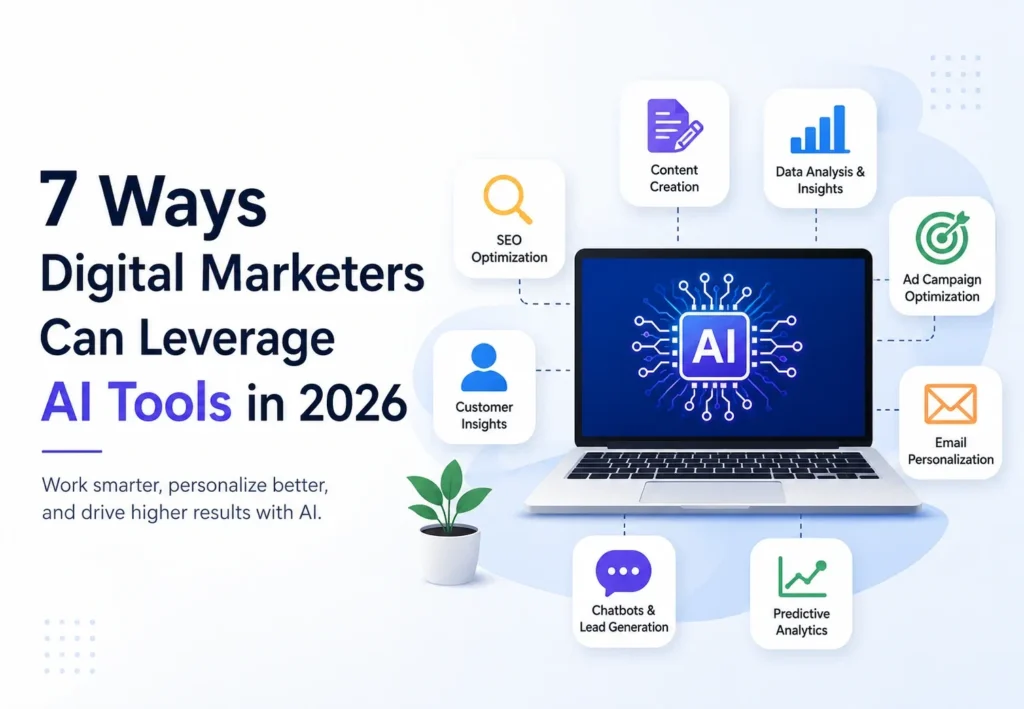
Artificial intelligence is transforming every stage of the digital marketing journey—from content creation and SEO to personalized customer experiences and campaign optimization. Instead of replacing marketers, AI empowers them to work smarter, automate repetitive tasks, and make data-driven decisions. The following seven benefits demonstrate how businesses can use AI to improve efficiency, boost engagement, and achieve better marketing results in 2026 and beyond.
1. Create High-Quality Content Faster
Content marketing remains one of the strongest growth channels, but creating quality content consistently is challenging. Modern AI writing assistants help marketers:
- Generate blog outlines
- Draft first versions
- Create product descriptions
- Write ad copy
- Generate social media posts
- Repurpose existing content
Best Practice to Follow
Don’t publish AI-generated content without human editing. Successful marketers use AI to accelerate research and drafting while adding:
- Industry expertise
- Brand voice
- Original examples
- Personal experience
- Data-backed insights
Example:
A SaaS company can use AI to create:
- Blog posts
- LinkedIn updates
- Email newsletters
- Webinar summaries
- Case study drafts
The role of the marketing team is to refine the content for accuracy and brand consistency.
2. Improve SEO with AI-Powered Research
SEO has become more data-driven than ever. AI tools can assist with:
- Keyword clustering
- Search intent analysis
- Topic research
- Content gap analysis
- Internal linking recommendations
- Competitor analysis
- On-page optimization
Instead of targeting isolated keywords, marketers can build topical authority around entire subject clusters.
For example, rather than writing only about “AI tool for digital marketing,” an AI-powered SEO workflow may suggest related topics such as:
- AI-powered SEO
- AI content optimization
- Marketing automation
- Predictive analytics
- AI keyword research
- AI customer insights
- AI campaign optimization
This creates a stronger content ecosystem that aligns with modern search engine expectations.
Related Article: Top Ways to Adapt SEO Strategy for LLM-Powered Search
3. Personalize Customer Experiences at Scale
Consumers expect personalized experiences across websites, emails, and advertisements. AI analyzes customer behavior using data such as:
- Purchase history
- Browsing patterns
- Search activity
- Location
- Device usage
- Engagement history
Based on the consumer behaviour, it then recommends personalized suggestions like:
- Product suggestions
- Email campaigns
- Landing pages
- Website content
- Promotions
Example:
An online fashion retailer can show personalized product recommendations, Dynamic discount offers, and customized email campaigns based on each visitor’s browsing history. This level of personalization significantly improves customer engagement and conversion rates.
4. Optimize Paid Advertising Campaigns
Managing PPC campaigns manually is becoming increasingly complex. AI can help marketers to optimize:
- Google Ads
- Meta Ads
- LinkedIn campaigns
- Performance Max campaigns
- Shopping campaigns
- Better audience targeting
- Bid adjustments
- Budget allocation
- Creative optimization
AI can also analyze thousands of data points, including:
- Audience behavior
- Device performance
- Time of day
- Geographic location
- Conversion probability
- Historical performance
Example:
Instead of splitting ad budgets evenly, AI may identify that mobile users from specific regions convert at a much higher rate and automatically prioritize those audiences.
5. Enhance Email Marketing with AI
Email remains one of the highest ROI marketing channels. AI can improve email marketing by helping marketers:
- Generate subject lines
- Predict open rates
- Optimize send times
- Personalize email content
- Recommend products
- Segment audiences automatically
Rather than sending identical emails to every subscriber, AI creates dynamic content tailored to each recipient, which ultimately improves productivity.
Example
A travel company could send:
- Beach vacation offers to families
- Adventure trips for younger audiences
- Luxury packages for premium customers
—all from a single automated campaign.
6. Use AI for Customer Support and Lead Generation
AI chatbots have evolved far beyond answering basic FAQs. Today’s AI assistants can:
- Qualify leads
- Schedule appointments
- Recommend products
- Answer complex questions
- Route conversations to sales teams
- Provide multilingual support
Because AI works around the clock, businesses can engage potential customers even outside working hours.
Advantage:
Instead of waiting several hours for a response, website visitors receive immediate assistance, improving customer satisfaction while increasing lead conversions.
7. Make Better Marketing Decisions with Predictive Analytics
One of AI’s greatest strengths is forecasting future outcomes. Rather than only reporting past performance, AI predicts:
- Customer lifetime value
- Churn probability
- Purchase intent
- Seasonal demand
- Revenue opportunities
- Campaign performance
Marketing leaders can use these insights to make smarter strategic decisions.
Example
An online electronics retailer preparing for a festive sale can forecast which product categories are likely to see increased demand and adjust inventory, advertising budgets, and promotional campaigns accordingly.
How to Use AI Tools in Digital Marketing Responsibly
AI is most effective when it complements human expertise—not when it replaces it. Follow these best practices:
- Always verify AI-generated facts.
- Maintain your brand voice.
- Protect customer data and comply with privacy regulations.
- Review AI-generated content before publishing.
- Use AI to assist decision-making rather than relying on it blindly.
- Measure outcomes and refine AI-driven workflows regularly.
The best results come from combining AI’s speed with human creativity, strategic thinking, and editorial judgment.
Type of Mistakes to Avoid
Many businesses fail to realize AI’s full potential because of avoidable mistakes.
Over-relying on AI
AI should support human expertise, not replace it entirely.
Publishing Without Fact-Checking
Always review statistics, product details, and technical information.
Ignoring Brand Voice
Generic AI-generated copy can weaken your brand identity. Customize every piece of content.
Using Too Many Tools
Instead of adopting numerous AI platforms, build a streamlined stack that integrates well with your existing workflows.
Neglecting Data Privacy
Ensure your AI tools comply with relevant privacy regulations and avoid uploading sensitive customer information unless appropriate safeguards are in place.
Future Trends in AI Every Digital Marketer Should Watch in 2026
The AI landscape continues to evolve rapidly. Key trends shaping digital marketing include:
- AI agents that automate multi-step marketing workflows.
- Hyper-personalized customer journeys powered by real-time behavioral data.
- AI-assisted video creation and editing for social platforms.
- Predictive customer segmentation with greater accuracy.
- Voice and visual search optimization.
- AI-powered analytics that deliver actionable recommendations rather than just reports.
- Integration of AI across CRM, marketing automation, and customer data platforms.
Related Article: 7 Ways CRM Software Helps Small Businesses Grow Faster
Organizations that combine these capabilities with strong governance and human oversight are likely to gain a competitive advantage.
Differences Between AI and Traditional Digital Marketing
| Feature | Traditional Marketing | AI-Powered Marketing |
|---|---|---|
| Content Creation | Manual | AI-assisted |
| Personalization | Limited | Highly personalized |
| Customer Segmentation | Static | Dynamic and real-time |
| Reporting | Historical | Predictive |
| Campaign Optimization | Manual | Continuous optimization |
| Customer Support | Human only | Human + AI |
| Decision Making | Experience-based | Data-driven insights |
Final Thoughts
Artificial intelligence is no longer an optional addition to a marketing toolkit—it’s becoming a core capability for businesses that want to stay competitive.
The right AI tool for digital marketing can streamline repetitive tasks, improve personalization, strengthen SEO, optimize advertising, and help teams make faster, data-driven decisions. However, AI delivers the greatest value when paired with human expertise, creativity, and ethical oversight.
If you’re wondering how to use AI tools in digital marketing, start small: identify one or two high-impact workflows—such as content creation or email personalization—measure the results, and expand from there. As AI technology continues to evolve, marketers who embrace experimentation while maintaining quality and trust will be best positioned for long-term success.
Frequently Asked Questions
What is an AI tool for digital marketing?
An AI tool for digital marketing uses artificial intelligence to automate tasks, analyze customer data, personalize campaigns, generate content, and improve marketing performance across channels such as search, email, social media, and paid advertising.
How can beginners start using AI in digital marketing?
Start with one use case, such as content drafting, keyword research, or email optimization. Review AI outputs carefully, measure results, and gradually expand AI into other marketing workflows.
Can AI replace digital marketers?
No. AI is designed to augment marketers by handling repetitive tasks and providing insights. Human creativity, strategic planning, relationship building, and decision-making remain essential.
Is AI-generated content good for SEO?
AI-generated content can perform well when it is accurate, original, helpful, and enhanced with human expertise. Simply publishing unedited AI text is unlikely to produce strong long-term SEO results.
What should businesses consider before adopting AI tools?
Evaluate ease of integration, data privacy practices, scalability, total cost of ownership, and whether the tool aligns with your team’s workflows and business objectives.

Rishi Pundir is an entrepreneur and author who enjoys exploring the latest business and technology trends, news, and insights across the web. He graduated in computer science and has years of experience in digital marketing. He is also passionate about writing in-depth articles on business, emerging technologies, innovations, digital marketing, and strategies for online business growth. He is the main editor of Trending Business Tips.