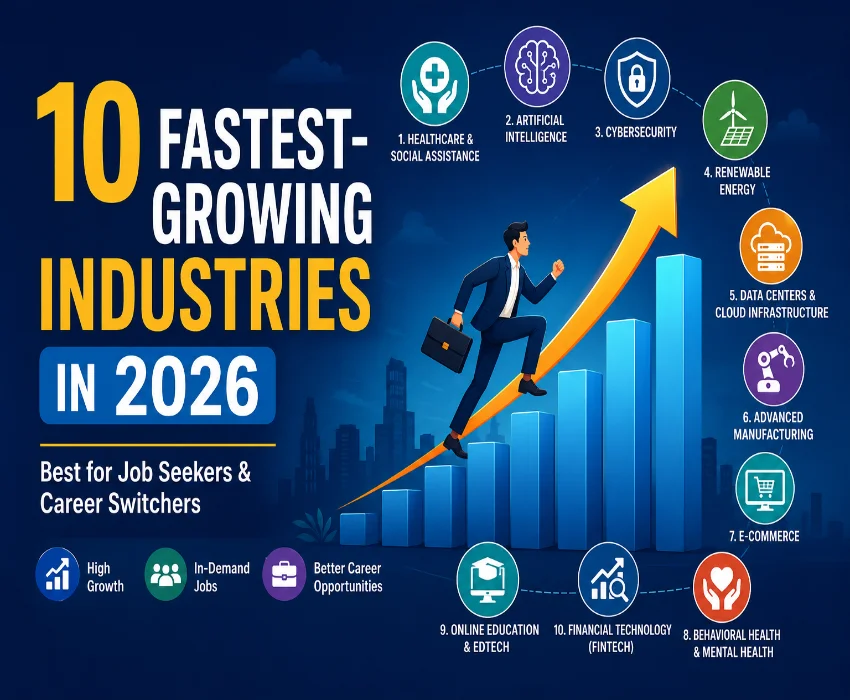
10 Fastest Growing Industries in 2026 (Best for Job Seekers & Career Switchers)
AI Generated
Last Updated on August 14, 2026 by Rishi
If you’ve been sending out applications and hearing nothing back, you’re not imagining things. Hiring has slowed in a lot of “safe” corporate roles, and a lot of career advice from even two years ago is already stale. But zoom out from the headlines about layoffs, and a different picture shows up: whole industries are still growing fast, adding jobs at two, three, sometimes ten times the pace of the overall economy.
That gap matters. The U.S. Bureau of Labor Statistics projects the economy will add 5.2 million jobs between 2024 and 2034, growing just 3.1% overall. But that growth isn’t spread evenly. A handful of sectors, led by healthcare, AI-driven tech, and clean energy, are expanding two to three times faster than everything else, and they’re the ones actually hiring right now.
This matters most if you’re job hunting, thinking about switching careers, or picking a field to train into. Applying into a shrinking or flat industry means competing for scraps. Applying into a growing one means employers are often short on qualified people, not the other way around.
Below are the 10 fastest-growing industries in 2026, the specific roles hiring within each one, and what it actually takes to get in the door, including if you’re switching in from somewhere else entirely.
Why “Fastest-Growing” Is the Metric That Actually Matters
Two numbers get thrown around when people talk about hot industries: revenue growth and job growth. They don’t always point the same direction. An industry can post huge revenue gains while automating away headcount, or grow modestly in dollars while adding a lot of jobs, because it’s labor-intensive.
For a job seeker, job growth is the number that matters. That’s why this list leans on BLS employment projections alongside industry hiring data, not just market-size reports.
The 10 Fastest-Growing Industries in 2026
1. Healthcare & Social Assistance
Healthcare is the single fastest-growing sector in the U.S. economy, projected to grow 8.4% through 2034, nearly three times the national average. An aging population and rising rates of chronic disease are driving sustained demand for care.
In-demand roles: Nurse practitioners (the fastest-growing occupation in healthcare, up 40%), physician assistants, physical therapist assistants, medical and health services managers, and home health and personal care aides, which is projected to add more new jobs than any other single occupation.
How to break in: Clinical roles require licensing, but administrative and management-track roles (medical billing, health services management, care coordination) offer a faster on-ramp for career switchers with organizational or operations experience.
2. Artificial Intelligence & Computer/Mathematical Occupations
AI has moved past the hype stage into implementation across nearly every industry. Computer and mathematical occupations are projected to grow 10.1%, over three times the economy-wide average, with data scientists specifically flagged by the BLS as one of the fastest-growing roles overall.
In-demand roles: Data scientists, machine learning engineers, AI/ML operations specialists, prompt and applications engineers, and business intelligence analysts.
How to break in: A computer science degree helps but isn’t mandatory anymore. Applied portfolios, project work, and demonstrated fluency with modern ML tooling increasingly carry more weight than credentials alone.
3. Cybersecurity
As data breaches and cyberattacks grow more frequent and more costly, demand for people who can secure business systems is climbing right alongside them.
In-demand roles: Information security analysts, security operations center (SOC) analysts, cloud security engineers, and compliance/risk specialists.
How to break in: Certifications like Security+, CySA+, or CISSP carry real weight here and are one of the more accessible ways for career switchers to get hired without a computer science background.
4. Renewable Energy (Solar & Wind)
Solar, wind, geothermal, and other clean power generation are, by percentage growth, the fastest-growing industries in the entire U.S. economy right now. Solar photovoltaic installers and wind turbine service technicians are consistently ranked among the two fastest-growing occupations nationally.
In-demand roles: Solar PV installers, wind turbine service technicians, energy efficiency specialists, battery storage technicians, and sustainability project managers.
How to break in: Many of these are trade-track roles, meaning a certificate program (often under a year) can get you hired, no four-year degree required.
5. Data Centers & Cloud Infrastructure
The AI boom runs on compute, and compute runs on data centers. Hyperscale data center construction and operations are expanding rapidly to keep up with AI workloads, cloud migration, and 5G expansion.
In-demand roles: Data center technicians, network and cloud infrastructure engineers, systems reliability engineers, and electrical/mechanical technicians who maintain facility infrastructure.
How to break in: IT support or electrical/HVAC trade backgrounds transfer well here, since data centers need both software and hardware/facilities expertise.
Related Article: Top 5 Semiconductor Companies
6. Professional, Scientific & Technical Services
This broad sector, covering software development, engineering, consulting, and R&D, is projected to grow 7.5%, driven largely by continued demand for AI systems, data processing, and specialized consulting.
In-demand roles: Software developers (projected to add more new jobs than almost any other single role), management consultants, UX/product designers, and technical project managers.
How to break in: This sector is relatively credential-flexible outside of specialized engineering roles; strong portfolios and freelance/contract experience often open doors.
7. Biotechnology & Life Sciences
Advances in precision medicine, drug development, and diagnostics continue to expand hiring in biotech and pharma-adjacent research.
In-demand roles: Biomedical researchers, laboratory technicians, clinical research associates, and regulatory affairs specialists.
How to break in: Lab technician and research-support roles are the most accessible entry points for career switchers with a science background who don’t yet have a graduate degree.
8. EV & Battery Manufacturing
Battery production for electric vehicles and grid storage is one of the fastest-growing manufacturing niches, expected to add tens of thousands of jobs as storage and EV adoption scale up.
In-demand roles: Battery production technicians, manufacturing engineers, quality control specialists, and industrial automation technicians.
How to break in: Manufacturing and industrial trade experience transfers directly; many employers run in-house training for battery-specific processes.
9. Elder Care & Services for the Elderly and Disabled
Beyond core healthcare, the standalone “services for the elderly and persons with disabilities” industry is projected to grow over 20%, adding more new jobs than almost any other single detailed industry, driven by rising demand for in-home and community-based care.
In-demand roles: Home care aides, care coordinators, occupational therapy aides, and case managers.
How to break in: Entry requirements are comparatively low; many roles offer paid training, making this one of the more accessible fast-growth fields for people without a degree.
10. Financial Services & Fintech
Digital transformation is reshaping banking, lending, and payments, driving demand for people who understand both finance and technology.
In-demand roles: Fintech product managers, data analysts, digital risk and compliance specialists, and payments engineers.
How to break in: A finance background paired with data or product skills (even self-taught) is increasingly more valuable to fintech employers than a traditional finance degree alone.
How to Actually Break Into a Fast-Growing Industry
Picking the right industry is only half the equation. A few things separate people who successfully switch into these fields from people who stay stuck applying:
- Target the entry-level roles inside the industry, not just the headline job titles. Every fast-growing sector has lower-barrier support roles (lab tech, SOC analyst, care coordinator) that lead into higher-paid specialist roles later.
- Use certifications and short courses to signal intent fast. You don’t need a new degree to switch into cybersecurity, renewable energy, or data-adjacent roles, you need proof you’ve done the work.
- Lean on transferable experience explicitly. Operations, coordination, customer-facing, and technical-support experience all transfer more directly than most career switchers assume.
- Follow the job growth number, not just the headlines. A sector can be “hot” in the news while barely hiring (small, high-growth-percentage industries), so check both growth rate and total new jobs before committing.
Mistakes to Avoid When Chasing a “Hot” Industry
- Chasing revenue headlines instead of hiring data. A sector can be booming financially while automating jobs away; always check employment projections specifically, not just market size.
- Ignoring geography. Renewable energy, data centers, and manufacturing growth are often concentrated in specific regions; a national growth rate doesn’t guarantee local openings.
- Assuming every role requires a full retraining. Many fast-growing fields have adjacent entry points that use skills you already have.
- Skipping the credentialing that actually matters. In fields like cybersecurity or healthcare, the “fast” way in usually still requires a specific certification or license, not just enthusiasm.
The Outlook Beyond 2026
None of these trends look like they’re reversing soon. Healthcare demand is locked in by demographics. AI adoption is still in its early-to-middle innings across most industries. The clean energy build-out is a decade-long infrastructure project, not a short-term policy trend. For job seekers, that means the industries on this list aren’t just growing in 2026, they’re likely to still be the safer bets in 2028 and beyond.
Final Thoughts
The job market isn’t uniformly slow, it’s uneven. Some industries are barely hiring; others can’t fill roles fast enough. The fastest-growing industries in 2026, healthcare, AI and tech, cybersecurity, clean energy, and a handful of others, are where that hiring gap is showing up most clearly.
If you’re job hunting or considering a switch, the practical move isn’t to chase the flashiest headline industry. It’s to pick one of these growing fields, identify the specific entry-level roles inside it, and build the one or two credentials that actually get you through the door. Growth alone won’t get you hired, but it puts the odds a lot more in your favor.
FAQs
Which industry is growing the fastest in 2026?
By percentage job growth, renewable energy (solar and wind power generation) and healthcare and social assistance are the fastest-growing sectors, though AI-adjacent computer and mathematical occupations are close behind.
What is the easiest fast-growing industry to switch into without a degree?
Renewable energy trades (solar installation, wind technician work) and elder/home care roles typically have the lowest barriers to entry, often requiring a short certificate program instead of a four-year degree.
Do I need to go back to school to switch into tech or AI?
Not necessarily. Many entry-level data and AI-adjacent roles now weigh applied projects and certifications as heavily as formal degrees, especially at smaller companies and startups.
Which fastest-growing industry pays the most?
Computer and mathematical occupations, particularly software development and data science, along with specialized healthcare management roles, tend to offer the highest median salaries among the fastest-growing fields.
Is healthcare really still a good industry to enter in 2026?
Yes. It remains the single fastest-growing sector by both percentage and total jobs added, driven by long-term demographic trends that aren’t going away.
How reliable are these growth projections?
The BLS employment projections are based on long-run economic modeling and are generally considered the most reliable public source for U.S. job growth data, though local and short-term hiring can vary from national trends.
Should I pick an industry based on growth rate or total number of jobs added?
Ideally both. A high growth rate in a very small industry (like wind turbine technicians) means fewer total openings than a moderately fast-growing but much larger industry (like healthcare support).

Rishi Pundir is an entrepreneur and author who enjoys exploring the latest business and technology trends, news, and insights across the web. He graduated in computer science and has years of experience in digital marketing. He is also passionate about writing in-depth articles on business, emerging technologies, innovations, digital marketing, and strategies for online business growth. He is the main editor of Trending Business Tips.