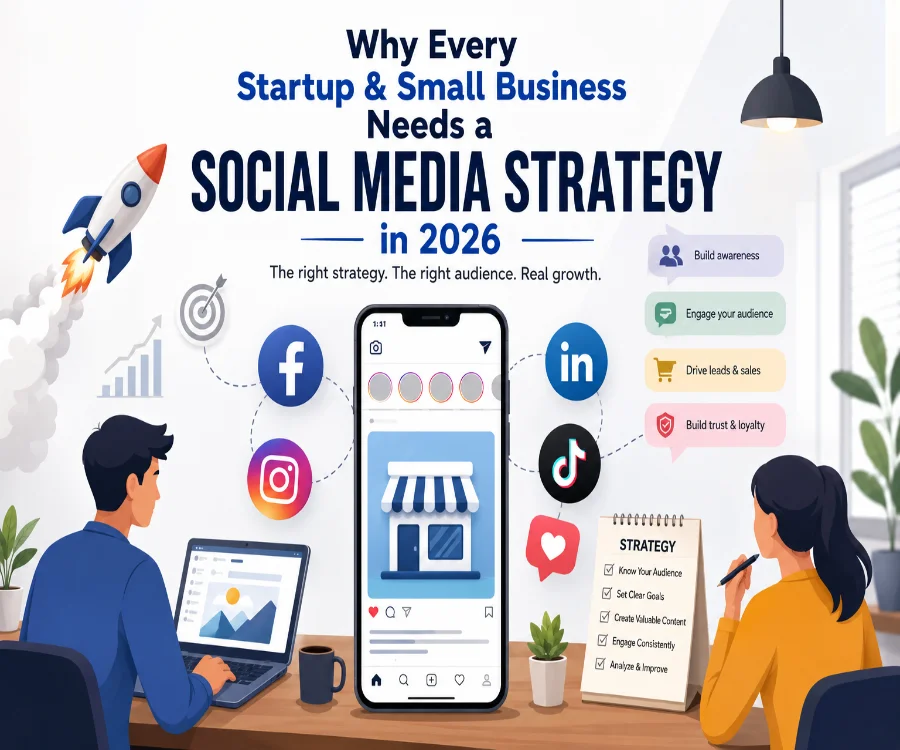
Why Every Startup and Small Business Needs a Social Media Strategy in 2026
AI Generated
Last Updated on August 17, 2026 by Rishi
Most startups already have a social media account. Few have a social media strategy — and that gap is quietly costing them customers. Posting when there’s news, sharing a product photo now and then, replying to comments whenever someone remembers to check the inbox: that’s activity, not strategy.
In 2026, with 5.79 billion people worldwide holding social media accounts — roughly 70% of the planet — the businesses winning attention aren’t the ones posting the most. They’re the ones posting with intent. This article breaks down why social media marketing for small businesses & startups has moved from “nice to have” to foundational, what it realistically costs, which platforms deserve your time, and how to build a strategy you can actually sustain — even with a two-person team and a tight budget.
What “Having a Social Media Strategy” Actually Means
A social media strategy isn’t a content calendar. It’s a decision about who you’re trying to reach, what you want them to do after seeing your content, and which platform gives you the best odds of that happening — backed by a way to measure whether it’s working. Without those three pieces, social media becomes a task you do because competitors do it, not a channel that actually grows the business.
Why Social Media Marketing Matters for Startups & Small Businesses in 2026
1. It’s Where Your Customers Already Are
People aren’t waiting to be found — they’re already scrolling. Social media has reached 5.79 billion user identities worldwide — roughly two in three people on Earth, and users now spend an average of 2 hours and 23 minutes online per day, active on 6–8 different networks (Blog2Social, 2026). For a startup with no brand recognition yet, that’s a distribution channel nothing else can match: your audience is already there, in a browsing mindset, before you spend a single rupee reaching them.
2. It Costs Less Than Almost Any Other Marketing Channel
Around 96% of small businesses now fold social media into their marketing mix, and those running paid social campaigns see an average return of $5 for every $1 spent (BizIQ, 2026). Compare that to traditional channels — print, radio, outdoor — where the entry cost alone can exceed a startup’s entire monthly marketing budget. Organic posting costs nothing but time; even a modest paid budget of a few hundred dollars a month can outperform channels that used to require five-figure spends.
3. It Builds Trust Before the First Sale
Founders tend to underestimate how much of a buying decision happens before someone even visits the website. A consistent, responsive social presence — reviews, behind-the-scenes posts, direct replies to questions — signals that a real, accountable business is behind the product. For early-stage companies with no track record, that visible activity substitutes for the reputation an established brand already has.
4. It Gives You Real-Time Customer Insight
Every comment, share, and click is data. Startups rarely have budget for formal market research, but social media hands them a live feedback loop: which messaging lands, which product angle gets saved and shared, which complaint keeps resurfacing. That insight should feed back into product and content decisions — not just sit unused in an analytics dashboard.
5. It Levels the Playing Field With Bigger Competitors
Reach on social platforms isn’t purchased by company size — it’s earned by relevance. A three-person startup with sharp, useful content can genuinely outperform an established competitor’s under-resourced social team. That’s a real structural advantage smaller businesses have, and most underuse it.
How Much Should a Startup or Small Business Spend on Social Media Marketing?
There’s no universal number, but the benchmarks give a useful range. The U.S. Small Business Administration recommends businesses under $5 million in revenue put 7–8% of gross revenue toward marketing overall, and social media typically accounts for 15–25% of that total (HubSpot/Statista, via Socioapt 2026). In practice, most small businesses land between $300 and $3,000 a month once content creation, tools, and paid promotion are combined — with roughly a quarter spending under $500 a month (The Manifest, 2026, as cited in the source above).
| Stage | Typical Monthly Spend | What It Usually Covers |
| Just starting out | $0 – $300 | Organic content only, founder-run |
| Building presence | $300 – $1,000 | Content + light paid boosting on 1–2 platforms |
| Scaling | $1,000 – $3,000 | Consistent paid ads, content support, basic analytics tools |
| Established SMB | $3,000+ | Multi-platform campaigns, freelancer or agency support |
Which Social Media Platform Is Right for Your Business?
Don’t try to be everywhere at once. 66% of small businesses now use unpaid social media as one of their top marketing channels, but the ones seeing real results pick platforms deliberately rather than by habit (LocaliQ, 2026).
| Platform | Best For | Avg. Engagement Rate |
| Broad reach, local discovery, community groups | 0.07% – 0.15% | |
| Visual products, D2C brands, younger audiences | 0.5% – 1.0% | |
| B2B startups, recruiting, thought leadership | 2% – 5% | |
| TikTok | Short-form storytelling, product demos, Gen Z reach | 5.69% (highest of all) |
Sources: Socioapt, 2026; Rival IQ, 2025 (as cited in the source above).
Common Mistakes Startups Make With Social Media Marketing
- Posting without a goal — no clear ask (visit the site, DM us, save this post) attached to the content
- Being everywhere at once — spreading thin across five platforms instead of doing one or two well
- Treating it as “free” — skipping even a small paid budget, then judging the channel a failure
- Going silent after launch — a burst of activity at launch, then months of nothing
- Ignoring the data — never checking which posts actually drove clicks, saves, or DMs
How to Build a Simple Social Media Strategy (5 Steps)
- Pick one primary platform based on where your specific audience spends time — not where competitors happen to post
- Set one measurable goal per quarter: website clicks, DM inquiries, or follower-to-customer conversion
- Build a lightweight content mix — roughly 40% educational/value content, 30% product or offer content, 30% behind-the-scenes trust-building
- Reserve a small, consistent paid budget rather than one-off boosted posts
- Review performance monthly and cut what isn’t working — don’t wait for a quarterly review to notice
These five steps overlap closely with the broader strategies to grow a small business you should already have in place — social media works best when it’s one piece of a coordinated plan, not a standalone effort.
What’s Next: Social Media Trends Startups Should Watch
Two shifts matter most for the rest of 2026. First, short-form video keeps pulling ahead on engagement — TikTok’s average engagement rate runs more than five times Instagram’s for business accounts, and other platforms keep copying the format. Second, AI-driven search and answer engines are starting to influence how people discover businesses, rewarding brands with a consistent, citable presence across channels — including social. Startups that treat social content as part of a broader visibility strategy, supported by the right online marketing tools for small businesses, are the ones positioned to benefit from both shifts.
Conclusion
Social media marketing isn’t optional for startups and small businesses anymore — it’s one of the few channels where a small team with a limited budget can compete directly with bigger, better-funded rivals. The businesses winning in 2026 aren’t posting more; they’re posting with a clear goal, on the right platform, backed by even a modest budget and a monthly habit of checking what’s actually working.
Start with one platform, one measurable goal, and a strategy you can sustain for six months. That’s a stronger foundation than a scattered presence across every network at once.
Frequently Asked Questions
Is social media marketing worth it for a very early-stage startup with no budget?
Yes. Organic posting costs nothing but time, and even pre-revenue startups can use it to test messaging and build an early audience before spending anything on ads.
How many platforms should a small business be on?
One or two, done consistently, beats five done sporadically. Choose based on where your specific customers spend time, not where every business is “supposed” to be.
What’s a realistic monthly social media budget for a small business?
Most small businesses spend $300–$3,000 a month once content creation, tools, and paid promotion are combined, though many start at $0 with organic-only content.
Which platform currently has the best engagement for a new business?
TikTok currently leads with an average engagement rate of 5.69%, though the “best” platform still depends entirely on where your target audience actually spends time.
How soon should a startup expect results from social media marketing?
Trust-building and brand awareness show up within a few months of consistent posting; measurable sales impact usually takes longer and depends on whether paid promotion is part of the mix.
Should a startup hire someone for social media or handle it in-house?
Most early-stage startups start founder-led or with one generalist hire, then bring in dedicated support — a freelancer or small agency — once monthly spend crosses into the $1,000+ range.
Related Articles:
Importance of Online Marketing Tools for Small Businesses

Rishi Pundir is an entrepreneur and author who enjoys exploring the latest business and technology trends, news, and insights across the web. He graduated in computer science and has years of experience in digital marketing. He is also passionate about writing in-depth articles on business, emerging technologies, innovations, digital marketing, and strategies for online business growth. He is the main editor of Trending Business Tips.