How to Write Better Prompts: A Guide to Prompt Engineering
Last Updated on October 8, 2026 by Rishi
Artificial intelligence tools have become part of everyday business operations. From content creation and customer support to reporting and coding, business owners are increasingly using AI to save time and improve productivity. However, many people fail to get useful results because they do not know how to communicate effectively with Generative AI systems.
This is where prompt engineering becomes valuable. A well-written prompt can transform a vague answer into a detailed, actionable response. As Generative AI adoption continues to grow, the ability to write better prompts is becoming a practical business skill rather than a technical specialty.
In this guide, you will learn what a prompt is, how prompt engineering works, its business benefits, common mistakes to avoid, and practical frameworks you can use across marketing, reporting, analysis, coding, and strategic planning tasks.
What Is a Prompt?
A prompt is the instruction, question, or context provided to Large Language Models (LLMs) to generate a response. Think of it as a briefing given to an employee. The quality of the output often depends on the quality of the instructions.
Example:
Weak Prompt:
“Write a blog post about SEO.”
Strong Prompt:
“Write a 1,000-word beginner-friendly blog post about local SEO for small businesses. Include practical examples, benefits, common mistakes, and a FAQ section.”
The second prompt provides clear expectations, resulting in a more useful response.
What Is Prompt Engineering?
Prompt engineering is the process of designing, refining, and optimizing prompts to generate better outputs from AI tools like ChatGPT, Claude, Grok, etc.
Rather than asking a simple question, prompt engineering involves:
• Defining objectives
• Providing context
• Specifying audience requirements
• Setting output formats
• Adding constraints and examples
Prompt engineering is not limited to content writing. It can be used for business reporting, coding, customer support, research, project planning, financial analysis, and decision-making.
Why Prompt Engineering Matters for Business Owners
Businesses are investing heavily in AI technologies. According to research from McKinsey, generative AI has the potential to create significant economic value across industries. However, achieving value depends largely on how effectively teams interact with AI systems.
Benefits of Prompt Engineering
1. Better Quality Outputs: Clear instructions reduce ambiguity and improve response accuracy.
2. Increased Productivity: Employees spend less time rewriting responses and more time acting on insights.
3. Consistent Results: Standardized prompts create repeatable workflows across departments.
4. Improved Decision-Making: Structured prompts can help generate reports, summarize data, and identify trends.
5. Cost Efficiency: Better prompts reduce manual effort and maximize the return on AI investments.
Related Article: How AI Is Reshaping Small Business Operations
Types of Prompts
Not all prompts serve the same purpose. Understanding the different types of prompts can help you choose the right approach for specific tasks, whether you’re generating content, analyzing data, solving problems, creating reports, or guiding AI to produce more accurate and relevant responses. Each prompt type offers unique advantages depending on the level of context, structure, and reasoning required. Here are the following types of prompts.
Instruction Prompts
Direct commands asking AI to perform a task.
Example:
“Create a product description for a wireless keyboard.”
Role-Based Prompts
Assign a professional role to guide the response.
Example:
“Act as a senior financial analyst and explain the company’s quarterly performance.”
Contextual Prompts
Provide background information before requesting output.
Example:
“Our target audience is small business owners. Create a social media campaign promoting accounting software.”
Chain-of-Thought Prompts
Encourage step-by-step reasoning.
Example:
“Analyze this sales decline and explain the possible causes step by step.”
Few-Shot Prompts
Provide examples before requesting new output.
Example:
Show two examples of email subject lines before asking for additional variations.
A Simple Framework for Writing Better Prompts
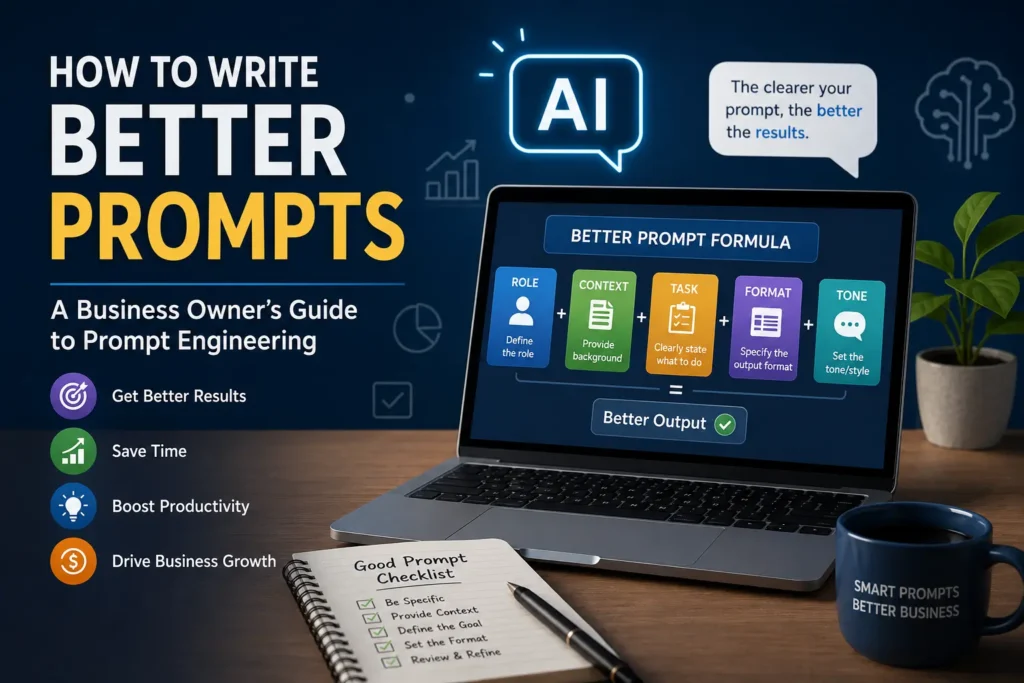
Writing effective prompts doesn’t have to be complicated. A simple framework like CRAFT helps you structure your instructions clearly so AI can understand your objectives, generate more accurate responses, and deliver outputs that align with your business needs. By defining the context, role, action, format, and tone, you can significantly improve the quality and consistency of AI-generated results across marketing, reporting, analysis, coding, and planning tasks. Here is the breakdown of “Craft” framework.
C – Context
Explain the background information.
R – Role
Define the expertise the AI should assume.
A – Action
Clearly describe the task.
F – Format
Specify how the output should be structured.
T – Tone
Define the writing style or communication approach.
Example:
“Act as a senior marketing consultant. Create a three-month content strategy for a SaaS startup targeting HR professionals. Present the output in a table and use a professional tone.”
Prompt Engineering Use Cases Across Business Functions
Prompt engineering can be applied across virtually every business function, helping teams automate repetitive tasks, improve decision-making, enhance productivity, and generate higher-quality outputs from AI tools. Here are some practical ways organizations are using prompt engineering to streamline their daily operations.
Marketing
AI can assist with:
• Content calendars
• Blog outlines
• Social media campaigns
• SEO recommendations
• Email marketing
Example Prompt:
“Act as an SEO strategist. Create a six-month content plan targeting small business owners interested in AI adoption.”
Related Article: How to Adapt SEO Strategy for LLM-Powered Search
Business Reporting
Prompt engineering helps transform raw information into actionable reports.
Example Prompt:
“Analyze the attached sales data and summarize key trends, opportunities, risks, and recommendations in executive-report format.”
Data Analysis
AI can help identify patterns and summarize findings.
Example Prompt:
“Review this customer feedback dataset and identify the five most common complaints and suggested solutions.”
Strategic Planning
Business leaders can use AI for brainstorming and scenario analysis.
Example Prompt:
“Act as a business consultant and evaluate three expansion opportunities for an e-commerce company entering new markets.”
Coding and Development
Developers use prompt engineering to:
• Generate code
• Debug applications
• Explain technical concepts
• Create documentation
Example Prompt:
“Act as a senior Python developer. Review this code and identify performance improvements.”
Common Prompt Engineering Mistakes
Even the most advanced AI tools can produce poor results when prompts are unclear or incomplete. By understanding and avoiding these common prompt engineering mistakes, you can improve output quality, reduce revisions, and get more accurate, actionable responses from AI.
Being Too Vague
Poor:
“Help me with marketing.”
Better:
“Create a 30-day LinkedIn content strategy for a B2B software company.”
Ignoring Context
AI performs better when given background information.
Not Specifying Output Format
Define whether you want:
• Tables
• Lists
• Reports
• Step-by-step instructions
• Executive summaries
Asking Multiple Unrelated Questions
Break complex tasks into smaller prompts for better accuracy.
Not Refining Results
Prompt engineering is often iterative. Review responses and provide additional instructions when necessary.
Prompt Engineering Best Practices
Below some of the prompt engineering best practices are described as:
• Start with a clear objective.
• Provide relevant context.
• Define the target audience.
• Specify output format.
• Use examples whenever possible.
• Test and refine prompts regularly.
• Create prompt templates for recurring tasks.
• Document successful prompts for team-wide use.
The Future of Prompt Engineering
Prompt engineering is evolving from a niche AI skill into a core business competency. As organizations integrate AI into daily workflows, employees who can communicate effectively with AI systems will have a competitive advantage.
Future developments may include:
• AI-powered workflow automation
• Multimodal prompts combining text, images, and data
• Industry-specific prompt libraries
• Personalized AI assistants trained on business knowledge
While AI models will continue improving, human guidance will remain essential for achieving accurate and relevant outcomes.
Conclusion
Prompt engineering is quickly becoming one of the most valuable business skills in the AI era. Whether you are creating marketing campaigns, analyzing data, generating reports, writing code, or planning business strategies, the quality of your prompts directly influences the quality of your results.
The most successful users of AI are not necessarily those with the most advanced tools. They are the people who know how to ask better questions, provide clearer instructions, and refine their requests strategically. By applying the frameworks and best practices covered in this guide, business owners can unlock more value from AI, improve efficiency, and make better-informed decisions across every department.
Frequently Asked Questions
1. Is prompt engineering only for technical professionals?
No. Business owners, marketers, analysts, and project managers can all benefit from prompt engineering.
2. Can prompt engineering help with business reporting?
Yes. Well-designed prompts can generate summaries, insights, dashboards, and executive reports.
3. How can beginners improve their prompts?
Focus on adding context, defining goals, specifying formats, and refining prompts based on results.
4. Does prompt engineering work for coding tasks?
Yes. Developers frequently use prompt engineering for code generation, debugging, documentation, and optimization.
5. What industries use prompt engineering?
Marketing, finance, healthcare, education, technology, retail, and consulting are actively using prompt engineering.
Related Article: Free Online Utility Tools to Improve Productivity

Rishi Pundir is an entrepreneur and author who enjoys exploring the latest business and technology trends, news, and insights across the web. He graduated in computer science and has years of experience in digital marketing. He is also passionate about writing in-depth articles on business, emerging technologies, innovations, digital marketing, and strategies for online business growth. He is the main editor of Trending Business Tips.