How Businesses Use AI to Increase Productivity
AI Generated
Last Updated on October 8, 2026 by Rishi
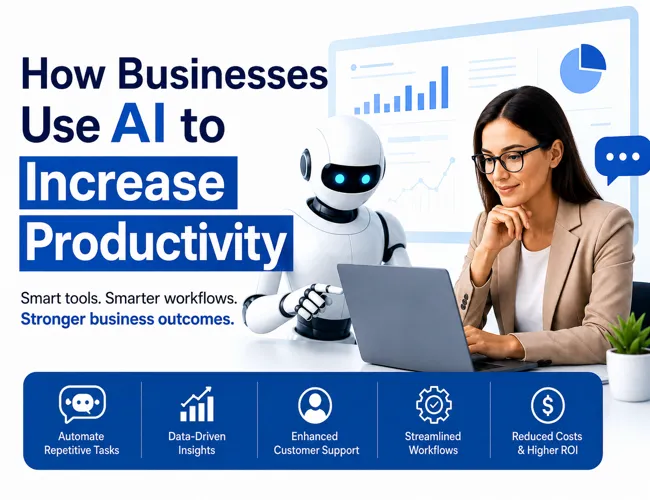
Artificial intelligence is no longer limited to tech giants or experimental projects. Today, businesses of all sizes are using AI to automate repetitive work, improve decision-making, reduce operational costs, and help employees focus on high-value tasks. From customer service automation to AI-powered analytics, companies are discovering practical ways to work smarter instead of simply working harder.
The growing adoption of AI is driven by major business needs such as efficiency, productivity, and management. Teams are expected to do more with fewer resources while maintaining speed and quality. That’s exactly where AI for business efficiency becomes valuable.
In this guide, you’ll learn how businesses use artificial intelligence to improve productivity and efficiency.
What is AI for Business Efficiency?
AI for business efficiency refers to using artificial intelligence technologies to improve operational performance, automate manual tasks, analyze data faster, and optimize business processes.
Instead of replacing employees, modern AI tools often work as “digital assistants” that help teams become more productive.
Businesses commonly use AI for:
- Automating repetitive workflows
- Managing customer interactions
- Data analysis and forecasting
- Marketing optimization
- Employee productivity
- Inventory and supply chain management
- Financial reporting
- Content creation and communication
The biggest advantage is speed. Tasks that previously took hours can now be completed in minutes with AI-powered systems.
How Does AI Increase Productivity?
One of the most common business questions today is: how does AI increase productivity? The answer lies in automation, accuracy, and faster decision-making. Here are the following ways in which AI can increase business productivity:
- Automating Repetitive Tasks
Employees spend a large portion of their workday on repetitive administrative tasks like:
- Data entry
- Scheduling meetings
- Email sorting
- Report generation
- Invoice processing
AI tools automate these activities, allowing employees to focus on strategy, creativity, and customer relationships.
Example:
A customer support team using AI chatbots can instantly answer common customer queries without human involvement. This reduces wait times and frees agents to handle complex cases.
- Faster Data Analysis
Modern businesses generate huge amounts of data every day. AI systems can process and analyze this data much faster than humans. AI helps businesses mainly in:
- Identify trends
- Forecast sales
- Detect fraud
- Predict customer behavior
- Improve business decisions
Real-World Use Case:
Retail companies use AI-powered analytics to predict inventory demand during holiday seasons. This helps prevent stock shortages and overstocking.
- Improving Employee Productivity
AI assistants reduce workload pressure by helping employees manage tasks more efficiently. Some of the examples include:
- AI writing assistants
- Meeting summarizers
- Smart project management tools
- AI-powered CRM systems
- Automated workflow software
Tools like Microsoft Copilot and Google Workspace AI help employees draft emails, summarize meetings, and organize workflows faster.
- Enhancing Customer Service
AI-powered customer support tools improve response times and customer satisfaction. Common AI customer service features include:
- Chatbots
- Voice assistants
- Sentiment analysis
- Automated ticket routing
- Personalized recommendations
This allows businesses to provide 24/7 support without dramatically increasing staffing costs.
- Streamlining Marketing Campaigns
Marketing teams of multiple companies are increasingly using AI for:
- Content generation
- Audience targeting
- SEO optimization
- Email personalization
- Ad campaign automation
AI tools analyze customer behavior and optimize campaigns in real time, improving ROI and reducing wasted ad spend.
What Does AI Help With in Business Operations?
Many businesses initially think AI only helps with automation. In reality, AI supports nearly every department.
Here’s a breakdown of what AI helps with in almost every business operation.
| Business Area | How AI Helps |
|---|---|
| Customer Support | Chatbots, ticket automation, instant responses |
| Marketing | Content creation, personalization, analytics |
| HR | Resume screening, employee onboarding |
| Finance | Fraud detection, forecasting, invoice processing |
| Sales | Lead scoring, CRM automation |
| Operations | Workflow optimization, predictive maintenance |
| E-commerce | Product recommendations, demand forecasting |
| Supply Chain | Route optimization, inventory planning |
Best AI Tools for Business Productivity
The most important thing to improve the productivity of businesses is to choose the right tools. Here are some of the best AI tools for business productivity that are currently popular among companies.
ChatGPT:
It is commonly used for:
- Content drafting
- Brainstorming
- Customer support assistance
- Research summaries
- Workflow automation
Grammarly:
It is commonly used for
- Writing quality
- Grammar
- Tone consistency
- Business communication
Notion AI:
It is commonly used for
- Team collaboration
- Meeting summaries
- Documentation
- Project management
Zapier:
This tool is commonly used for automating workflows between apps without coding.
Examples:
- Auto-saving leads
- Sending notifications
- CRM integrations
- Marketing automation
HubSpot:
Some of its features are very helpful in
- Email automation
- Lead management
- Marketing analytics
- CRM workflows
Semrush:
It is a very popular online marketing tool. It mainly offers
- Keyword research
- SEO optimization
- Competitor analysis
- AI-assisted content planning
How Does AI Reduce Costs?
AI reduces costs in several practical ways. Here are some of those:
Lower Labor Costs for Repetitive Work
AI automation reduces the need for manual processing in repetitive tasks. This allows businesses to operate efficiently without continuously expanding teams.
For example:
- Invoice automation
- Data entry
- Appointment scheduling
- Basic customer support
Reducing Human Errors
Mistakes in finance, operations, or customer service can be expensive. Fewer errors often mean lower operational losses. AI systems improve accuracy in:
- Data processing
- Fraud detection
- Reporting
- Forecasting
Optimizing Resource Allocation
AI analytics help businesses understand:
- Which products perform best
- Where budgets are wasted
- Which marketing channels generate ROI
- How employees spend time
Predictive Maintenance
Manufacturing and logistics companies use AI to predict equipment failures before they happen. This helps reduce:
- Downtime
- Repair costs
- Production delays
According to IBM, AI-powered predictive maintenance can significantly improve operational efficiency in industrial environments.
Challenges and Risks of AI Adoption
While AI offers major advantages, businesses should also understand the challenges. Here are some of the challenges faced by businesses in AI adoption.
Initial Investment Cost
Advanced AI systems can require Software subscriptions, Infrastructure upgrades, and Employee training.
Data Privacy Concerns
AI systems depend heavily on data. For that, businesses must ensure compliance with regulations like GDPR, Data protection policies, and Cybersecurity standards.
Employee Resistance
Some employees fear AI may replace jobs. However, successful businesses focus on AI as a productivity enhancement tool rather than a replacement strategy.
Poor AI Implementation
Many companies adopt AI tools without clear goals. This often leads to wasted budgets, Low adoption rates, and Inefficient workflows.
Mistakes Businesses Should Avoid When Using AI
Here are some of the mistakes that businesses should avoid when using artificial intelligence.
Adopting AI Without a Clear Goal
Businesses should define measurable objectives before investing in AI.
Examples:
- Reduce customer response time
- Automate invoice processing
- Improve lead conversion rates
Ignoring Employee Training
AI tools only work effectively when teams understand how to use them properly. Employee training should be part of every AI rollout strategy.
Relying Entirely on Automation
AI should support human decision-making, not completely replace it. Human oversight remains important for:
- Creativity
- Strategic planning
- Ethical decisions
- Customer relationships
Using Too Many AI Tools
Businesses sometimes overload workflows with disconnected AI software. It’s better to focus on a few tools that integrate well together.
Conclusion
AI is transforming the way businesses operate. From automating repetitive tasks to improving customer service and decision-making, AI tools are helping companies become faster, smarter, and more efficient.
The biggest advantage of AI for business efficiency is not simply automation — it’s the ability to help teams focus on meaningful, high-impact work while reducing operational friction.
Businesses that adopt AI strategically can improve productivity, lower costs, and stay competitive in a rapidly changing digital landscape. However, success depends on choosing the right tools, training employees properly, and implementing AI with clear business goals.
Frequently Asked Questions
Is AI only useful for large businesses?
No. Small and medium-sized businesses can also benefit from affordable AI tools for automation, marketing, customer support, and productivity.
How does AI increase productivity in the workplace?
AI automates repetitive tasks, speeds up data analysis, improves communication, and helps employees focus on higher-value work.
What does AI help with the most in business?
AI commonly helps with automation, customer support, marketing optimization, analytics, forecasting, and workflow management.
How does AI reduce costs for companies?
AI reduces labor costs, minimizes human errors, improves operational efficiency, and optimizes resource allocation.
What are the best AI tools for business productivity?
Popular tools include ChatGPT, Claude, Gemini, Grammarly, Notion AI, Zapier, HubSpot, and Microsoft Copilot.
Can AI replace human employees?
AI can automate certain tasks, but human skills like creativity, leadership, emotional intelligence, and strategic thinking remain essential.
Is AI expensive to implement?
Costs vary depending on the tool and business size. Many cloud-based AI tools are affordable for small businesses.
What industries benefit the most from AI?
Industries such as healthcare, finance, retail, manufacturing, logistics, and marketing are seeing significant productivity gains from AI adoption.
Related Article: Free Online Utility Tools to Improve Productivity

Garima Gaur is a senior writer and also a renowned guest author on many popular platforms like goodmenproject.com. She loves to write on topics like business, finance, technology, marketing, and many more.