Top 5 Google I/O 2026 Highlights and Announcements: Everything You Need to Know
AI Generated
Last Updated on May 22, 2026 by Rishi
Google I/O 2026 just wrapped up, and it was packed. Held on May 19–20 at the Shoreline Amphitheatre in Mountain View, California, this year’s developer conference made one thing clear — the agentic AI era is no longer a concept. It’s here, and it’s shipping.
CEO Sundar Pichai opened the keynote, noting that over the last ten years, we pivoted Google to become an AI-first company. AI is now showing up in the products that billions of people use every day. Here are the top 5 Google I/O 2026 highlights you need to know about.
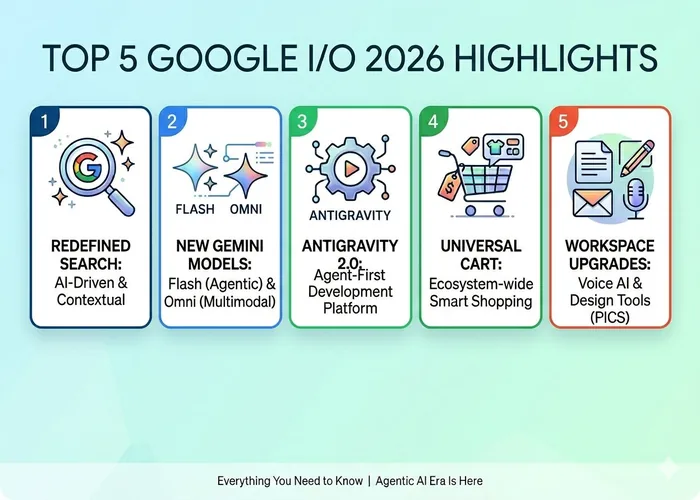
Google Search Gets Its Biggest Upgrade in Nearly 25 Years
Google Search has looked and worked more or less the same way for decades. That changes now.
The redesigned Search experience moves far beyond a text input box. The new intelligent search bar offers AI-driven suggestions, supports voice, image, and file inputs, and delivers contextual results rather than just a list of links. The shift is from keyword matching to genuine understanding — you ask a question in plain language, and Search actually figures out what you mean.
The biggest addition is the integration with Gemini Spark. When connected, a Search query becomes agentic — instead of giving a one-time result, Search continues to monitor and update you as new information becomes available.
For businesses, this is a major signal. SEO strategies built purely around keyword rankings will need to evolve toward content that clearly and directly answers real user questions — because that’s what AI-powered Search will surface. The new experience began rolling out on the day of the announcement.
New Gemini Models: Gemini 3.5 Flash and Gemini Omni
Google introduced two significant new AI models at I/O 2026, each targeting a different use case.
Gemini 3.5 Flash is the first model in Google’s new generation that combines intelligence with the ability to take action. It outperforms the previous Gemini 3.1 Pro on coding, agentic, and multimodal benchmarks — while running at 4x faster output speeds. It’s available immediately in the Gemini app, Google Search, Antigravity 2.0, and the Gemini API. A more powerful Gemini 3.5 Pro is in testing and expected next month.
Gemini Omni is Google’s new multimodal model built to handle any type of input — text, images, audio, and video — and generate outputs across those same formats. It’s designed for real-time, interactive applications and represents a genuine leap in video understanding and editing. A faster Omni Flash version launched immediately for paid subscribers, with a more powerful Omni Pro available via API for developers.
Together, these models signal that Google is serious about competing at the frontier — both in capability and everyday usability. For developers, Gemini 3.5 Flash in particular offers enterprise-grade intelligence at accessible speed and cost.
Google Antigravity 2.0: The Agent-First Development Platform
Developers had plenty to celebrate at I/O 2026, with Antigravity 2.0 as the standout announcement for the technical crowd.
Antigravity is Google’s platform for building AI agents — software that can plan, reason, and complete multi-step tasks autonomously. Version 2.0 is a major step forward: it’s reportedly 12x faster than its predecessor, dramatically reducing token usage and keeping project costs down.
Key features in Antigravity 2.0:
- Multi-agent orchestration — spin up multiple specialized AI subagents running in parallel on complex workflows
- Antigravity CLI — a new command-line interface for developers who prefer the terminal
- Built-in security — cross-platform sandboxing, credential masking, and hardened Git policies included by default
- Google AI Studio integrations — native Kotlin support, Firebase services, one-click Cloud Run deployment, and seamless project export
One of the most talked-about live demos of the entire keynote showed Antigravity building a working operating system on stage — capable of running the classic game Doom — in a matter of seconds. It was the kind of moment that makes developers genuinely rethink what’s possible.
For businesses building internal tools, automating workflows, or creating customer-facing AI products, Antigravity 2.0 meaningfully lowers the barrier to entry.
Universal Cart: AI-Powered Shopping Across Google’s Entire Ecosystem
If there was one announcement that resonated most with everyday users, it was Universal Cart — and it’s easy to see why.
Universal Cart is a single, intelligent shopping cart that works across Google Search, the Gemini app, YouTube, and Gmail. The moment you add a product, the AI gets to work behind the scenes.
Here’s what it does automatically:
- Monitors price history and alerts you when prices drop
- Notifies you when out-of-stock items become available again
- Flags product incompatibilities and suggests better alternatives before you buy
- Factors in your payment method, perks, and loyalty program benefits
- Can complete the entire checkout process on your behalf
A standout demo on stage showed a user building a custom PC by adding components from multiple retailers. Universal Cart detected that two parts were incompatible, suggested a replacement, and found a better deal — all without a single manual search.
Universal Cart rolls out across Google Search and the Gemini app in summer 2026, with YouTube and Gmail integration coming later. Google is also expanding its Universal Commerce Protocol to cover hotels and food delivery.
For retailers and e-commerce brands, being visible and competitive inside Google’s commerce ecosystem will matter more than ever as purchasing behavior shifts.
Google Workspace Gets Voice AI and New Design Tools
Google Workspace users received a meaningful upgrade at I/O 2026, with a strong focus on voice-first interaction and smarter productivity tools.
Docs, Gmail, and Keep now support natural voice commands for a wide range of tasks. Users can dictate drafts, take notes, search their inbox, and run contextual commands entirely by speaking. Google also re-engineered the microphone experience so users can speak at their own pace without being interrupted or cut off — a small change that makes a big difference in everyday use. Regional dialect options are rolling out in the coming weeks.
Google Pics, a new AI-powered design tool, was unveiled as part of the Workspace family — positioned as a fast, conversational way to create visuals without needing dedicated design software.
AI Inbox received updates focused on smarter email prioritization and management, helping professionals cut through inbox clutter more efficiently.
For teams that rely on Google Workspace, these updates represent a genuine shift toward a voice-native, AI-assisted workflow that could meaningfully cut time spent on routine tasks.
Final Thoughts
Google I/O 2026 was one of the most focused developer conferences Google has ever held. Every major announcement pointed toward the same direction: AI that doesn’t just assist you, but actively works for you.
Whether you’re a developer, a business owner, a marketer, or just a daily Google user, these changes are coming to your workflow sooner than you might expect. The agentic era isn’t a future roadmap item anymore — it’s this summer’s update.
Frequently Asked Questions
What is the biggest announcement at Google I/O 2026?
The most transformative announcements were Gemini Spark (a 24/7 personal AI agent), Universal Cart, and the redesigned Google Search — all pointing toward AI that takes action, not just provides information.
What is Gemini 3.5 Flash?
It’s Google’s newest AI model that combines frontier intelligence with agentic capabilities. It outperforms the previous Gemini 3.1 Pro while running 4x faster, and is available today in the Gemini app and Google AI Studio.
What is Universal Cart, and when does it launch?
Universal Cart is an AI-powered shopping cart that works across Google Search, Gemini, YouTube, and Gmail. It tracks prices, flags incompatibilities, and can complete purchases for you. It rolls out in summer 2026.
What is Google Antigravity 2.0?
It’s Google’s agent-first development platform — now 12x faster — for building multi-agent AI applications. It includes orchestration tools, a CLI, an SDK, and built-in security features.
How has Google Search changed in 2026?
Search now supports voice, image, and file inputs, delivers AI-driven contextual results, and integrates with Gemini Spark to provide ongoing, agentic updates rather than one-time results.
What new Workspace features were announced?
Docs, Gmail, and Keep now support voice commands, a new design tool called Google Pics was launched, and AI Inbox received smarter email management updates.

Rishi Pundir is an entrepreneur and author who enjoys exploring the latest business and technology trends, news, and insights across the web. He graduated in computer science and has years of experience in digital marketing. He is also passionate about writing in-depth articles on business, emerging technologies, innovations, digital marketing, and strategies for online business growth. He is the main editor of Trending Business Tips.