How to Write a Cover Letter for Job Application in 2026: A Practical Guide
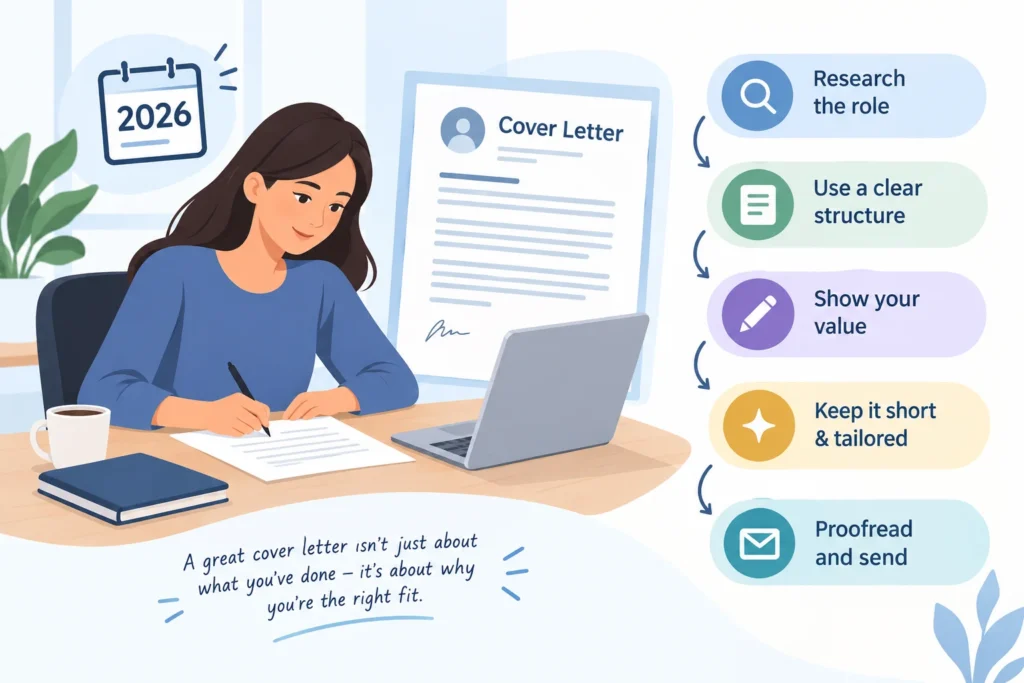
AI Generated
Last Updated on October 18, 2026 by Garima Gaur
You’ve found the right role, your resume is ready, and then the portal asks for a cover letter. Suddenly you’re staring at a blank page. You’re not alone: in a July 2026 survey by Novorésumé, 47.3% of U.S. job seekers said they had skipped at least one job because it required one.
That’s a missed opportunity. Knowing how to write a cover letter that sounds specific and human is one of the cheapest ways to stand out, especially now that generic, AI-polished applications are everywhere. Whether it’s a cover letter for job application portals or a direct email to a recruiter, the principles are the same.
In this guide, you’ll see whether cover letters still matter in 2026, the cover letter structure that works, professional cover letter examples you can adapt, and cover letter writing tips for the AI era.
Do Cover Letters Still Matter in 2026?
Yes, but who reads yours depends on who opens your file. The data looks contradictory until you separate the readers.
A survey of 625 U.S. hiring managers by Resume Genius found that 83% read most cover letters they receive, 45% read the letter before the resume, and 94% say it influences who gets interviewed. Even at companies that don’t require one, 73% still read it.
Recruiters tell a different story. Novorésumé’s Hiring Landscape survey of 200+ HR professionals found that about 60% read cover letters, but 52.8% of recruiters skip them entirely, compared with only 22.9% of HR managers.
| Reader | What the survey found |
| Hiring manager (Resume Genius, 625 U.S. managers) | 83% read most letters; 45% read the letter before the resume |
| HR manager (Novorésumé, 200+ HR professionals) | Only 22.9% skip them; 33.3% read the letter first |
| Recruiter (Novorésumé) | 52.8% skip cover letters entirely |
The takeaway: write for the person making the shortlist decision, not the first-pass screener.
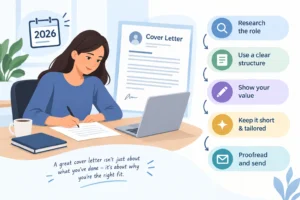
Before You Write: Research the Role
- Decode the job description. Highlight the outcomes the employer cares about. Resume Genius’s hiring managers ranked matching your skills to the posting as the top way to tailor a letter.
- Find one real detail about the company. A recent launch or interview works. One genuine detail beats three paragraphs of flattery.
- Name the reader. Check the posting or LinkedIn for the hiring manager. If you can’t find a name, “Dear Hiring Manager” was the most preferred generic greeting in the Resume Genius survey.
- Pick your proof. Choose two achievements with numbers, such as revenue, time saved or traffic grown, that map to the role.
Cover Letter for Job Application: The Structure That Works in 2026
A clear cover letter structure keeps you to one page and makes your letter easy to skim. Aim for four parts.
1. Header and Greeting
Add your name, email, phone number and LinkedIn URL, then the date and the employer’s details. Address the hiring manager by name wherever possible.
2. Opening Paragraph: Hook Them Fast
This part counts most: 41% of hiring managers in the Resume Genius survey said the introduction leaves the biggest impression. Lead with the role and your most relevant result, or a genuine reason you want this job. Skip “I am writing to apply for…”
3. Body: Prove You Can Do the Job
Use one or two short paragraphs. Take the employer’s top two needs and show how you’ve met them before: the situation, what you did and the result. Then add a sentence on why this company, not just any company. If you’re changing careers or explaining an employment gap, this is where you do it briefly and positively.
4. Closing: Make the Next Step Easy
Restate your interest in one line, mention what you’d bring, and invite a conversation. Close with “Best regards” or “Sincerely” and your name.
Professional Cover Letter Examples: Weak vs. Strong
Small wording changes make a big difference. Here’s how to upgrade common openings and claims (examples are illustrative).
| Weak | Strong |
| “I am writing to apply for the Content Marketing Manager position.” | “Last year I grew organic sign-ups 38% for a fintech start-up. I’d like to bring that approach to your content team.” |
| “I’m a hard-working team player with great communication skills.” | “I led four writers and cut turnaround from nine days to five.” |
Here’s a short sample you can adapt (names and numbers are fictional):
Dear Ms. Carter,
Last year I grew organic sign-ups by 38% for a fintech start-up by rebuilding its blog around customer questions. When I saw your opening for a Content Marketing Manager, I recognized the same challenge: a strong product, and content that doesn’t yet answer what buyers are asking.
At Brightline, I led four writers and cut turnaround from nine days to five without losing quality. I’d bring that mix of editorial judgment and measurement to your team.
I’d welcome a conversation about your content plans. Thank you for your time.
Best regards,
Jordan Lee
Cover Letter Writing Tips for 2026
- Keep it short. Resume Genius’s hiring managers preferred about 400 words on average. Aim for 250–400 words and never go past one page.
- Send a PDF. Unless the portal or applicant tracking system (ATS) asks for something else, a PDF keeps your formatting intact and was the format hiring managers preferred. Name it clearly, such as FirstName-LastName-Cover-Letter.pdf.
- Lead with results, not adjectives. “Cut reporting time by 40%” beats “hard-working and detail-oriented.”
- Match the tone to the company. A start-up can be warmer and more conversational. A bank or law firm usually expects a more formal register.
- Don’t repeat your resume. Use the letter for what a resume can’t carry: motivation, context and the story behind a number.
How to Use AI for Your Cover Letter Without Sounding Like AI
AI is now part of the process. In Novorésumé’s July 2026 survey of 1,000 U.S. job seekers, 46.8% used generative AI on their last cover letter, and 32.4% had sent a barely edited AI letter at least once. Hiring managers are watching: in an Insight Global survey of 1,005 hiring managers (as reported by Novorésumé), 88% said they can tell when AI was used and 54% said they would care. Among those who care, 36% saw it as a positive sign of tech skills, while 24% read it as low effort.
So the problem isn’t AI itself. It’s unedited text. A workable process:
- Give ChatGPT or a similar tool the job description, your resume and two achievements, and ask for an outline or first draft.
- Replace every generic claim with something only you can say: a named project, a number, a reason.
- Cut stock phrases like “results-driven professional” and “passionate team player.”
- Read it aloud. If it doesn’t sound like you on a good day, rewrite it.
Conclusion
Cover letters aren’t dead, but generic ones are. Hiring managers still read them, and tailoring is what moves callbacks. To recap how to write a cover letter that works: research the role, open with proof, follow a clean one-page structure, keep it to 250–400 words, edit AI drafts until they sound like you, and proofread before sending. Do that, and your application will read as a person wrote it for this job, because one did.
Frequently Asked Questions
How long should a cover letter be?
Roughly 250–400 words, and never more than one page. Resume Genius’s hiring managers preferred about 400 words on average.
Do I need a cover letter if it’s optional?
Usually it’s worth sending one. At companies that don’t require it, 73% of hiring managers in the Resume Genius survey still read it. The exception: if the posting says not to send one, follow that.
How do I start a cover letter if I don’t know the hiring manager’s name?
Look on LinkedIn or the company website first. If you can’t find it, “Dear Hiring Manager” is a safe, widely preferred choice.
Is it okay to use ChatGPT for a cover letter?
Yes, as a drafting aid, as long as you edit it heavily and add specifics only you know. Unedited AI text is what hiring managers say they can spot.
Related Article:
How to Write a Resume
How to Improve Communication Skills for Career Growth

Garima Gaur is a senior writer and also a renowned guest author on many popular platforms like goodmenproject.com. She loves to write on topics like business, finance, technology, marketing, and many more.