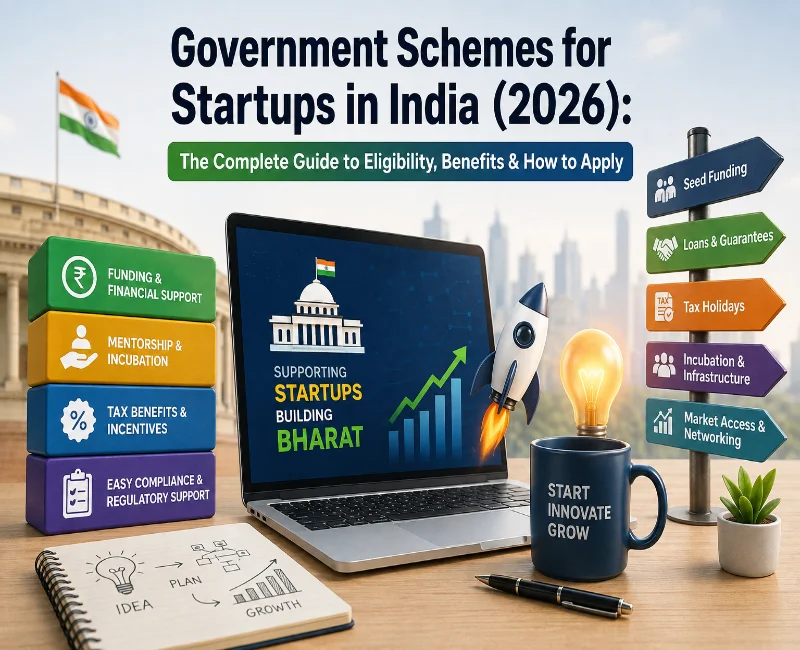
Government Schemes for Startups in India (2026): The Complete Guide to Eligibility, Benefits & How to Apply
AI Generated
Last Updated on August 24, 2026 by Rishi
Every founder eventually hits the same wall: a great idea, a working prototype, and a bank balance running out faster than expected. Private investors are an option, but they come with strings attached — equity dilution, high interest rates, sometimes a loss of control. This is exactly where government schemes for startups in India step in — and in 2026, there are more of them, covering more stages of a business, than at any point in the last decade.
As of January 2026, DPIIT had officially recognised over 2.12 lakh startups under the Startup India initiative, with more than 1 lakh of them having at least one woman director or partner, according to government data published by the Press Information Bureau. That scale isn’t an accident — it’s the result of a decade of policy-building, funding programmes, and tax incentives designed to make entrepreneurship less risky.
Understanding which government schemes for business startup ventures you actually qualify for can be the difference between bootstrapping painfully and scaling with real support. This guide is built as a complete reference — not a quick list — covering central schemes with their exact benefits, eligibility, and application process; a state-by-state breakdown of what your local government offers on top of central support; and the mistakes that trip up most first-time applicants.
Why Government Schemes for Startups Matter More in 2026
Early-stage capital is still concentrated in a handful of metro cities and sectors, leaving Tier-2/Tier-3 founders, first-generation entrepreneurs, and non-tech businesses underserved by private VC money.
Government schemes fill that gap with three things private capital rarely offers: money without equity dilution, reduced compliance burden, and structural support like incubation and mentorship. According to the Department for Promotion of Industry and Internal Trade, these programmes span sectors from technology and manufacturing to agriculture and healthcare — lowering the odds that a good idea dies before it gets a fair shot.
Central Government Schemes for Startups in India: Quick Comparison
Before the detailed breakdown, here’s a snapshot of the major central government schemes for startups and what each one is actually built to solve.
| Scheme | Core Benefit | Who It’s For | Managed By |
| Startup India (DPIIT Recognition) | 3-year tax holiday, 80% patent fee rebate, self-certification | Private Ltd/LLP, under 10 years, turnover under Rs 200 crore | DPIIT |
| Startup India Seed Fund Scheme | Up to Rs 20 lakh grant + up to Rs 50 lakh debt/CCD | Early-stage startups (idea to prototype), incorporated under 2 years | DPIIT via incubators |
| Fund of Funds for Startups | Indirect equity via SEBI-registered VC funds | DPIIT-recognised startups seeking VC backing | SIDBI |
| Credit Guarantee Scheme for Startups | Collateral-free loans, government covers 75-85% default risk | DPIIT-recognised startups needing working capital/term loans | NCGTC |
| Atal Innovation Mission | Incubation infrastructure, mentorship, grant-in-aid to incubators | Innovation and deep-tech focused founders | NITI Aayog |
| MUDRA Yojana (PMMY) | Collateral-free micro-loans up to Rs 10 lakh | Micro and non-corporate small businesses | Member banks/NBFCs |
| Stand-Up India | Composite loans of Rs 10 lakh to Rs 1 crore | Women and SC/ST first-time entrepreneurs | Scheduled commercial banks |
| Production-Linked Incentive Scheme | 4-6% cash payout on incremental sales | Manufacturing units in 14 notified sectors | Respective ministries |
| National SC-ST Hub | 4% procurement quota, tender fee waivers, skilling support | SC/ST-owned micro and small enterprises | Ministry of MSME |
Central Government Schemes for Startups in India (Detailed Breakdown)
Each of the following is a genuine central government scheme, with its own eligibility rules, benefit structure, and application route. Read the eligibility section carefully before applying — mismatched applications are the single biggest reason founders get rejected or delayed.
1. Startup India Initiative and DPIIT Recognition
This is the foundation everything else is built on. DPIIT recognition doesn’t hand you money directly, but it’s the gateway that unlocks nearly every other central scheme in this guide.
Benefits
- Three-year income tax holiday under Section 80-IAC on profits (available for any 3 consecutive years within the first 10)
- 80% rebate on patent filing fees and 50% rebate on trademark filing fees
- Self-certification under 6 labour laws and 3 environmental laws, reducing inspection burden in the early years
- Exemption from angel tax on investments that meet prescribed conditions
- Easier public procurement — exemption from prior turnover and experience requirements in government tenders
- Faster winding up — eligible startups can be wound up within 90 days under the Insolvency and Bankruptcy Code
Eligibility
- Entity registered as a Private Limited Company, LLP, or registered Partnership Firm
- Incorporated for less than 10 years (extended to 20 years for biotechnology and select deep-tech startups)
- Annual turnover has not exceeded Rs 200 crore in any financial year since incorporation
- Not formed by splitting up or reconstructing an already existing business
- Working towards innovation, development, or improvement of products, processes, or services, or has a scalable business model with high potential for employment/wealth creation
How to Apply
- Incorporate your entity and obtain your Certificate of Incorporation/Registration
- Create a profile on the Startup India portal and fill in company, director, and business details
- Write a clear description of what is innovative or scalable about your product, service, or process
- Submit the DPIIT recognition application with incorporation certificate, PAN, and any supporting documents (website, pitch deck, or patent details)
- Track application status on the portal; recognition is generally granted within a few weeks once documentation is complete
Official source: Startup India — Government Schemes Portal
2. Startup India Seed Fund Scheme (SISFS)
SISFS is arguably the most useful scheme for founders still validating an idea, since it’s designed for the proof-of-concept and prototype stage — before most VCs will even take a meeting.
Benefits
- Up to Rs 20 lakh as an interest-free grant for proof-of-concept, prototype development, and product trials
- Up to Rs 50 lakh through convertible debentures or debt-linked instruments for market entry and commercialisation
- Milestone-based disbursal, so funds are released in tranches as you hit agreed targets rather than all at once
- Backed by a Rs 945 crore central corpus, disbursed through a network of DPIIT-selected incubators across the country
Eligibility
- DPIIT-recognised startup, incorporated not more than 2 years before the date of application
- Business idea for a new product, service, or process not implemented by more than 51% of any other startup
- Indian promoters must hold at least 51% shareholding at the time of application
- Should not have received more than Rs 10 lakh of monetary support under any other central or state government scheme (with some exceptions)
How to Apply
- Get your DPIIT recognition first, as this is a prerequisite
- Identify an eligible incubator from the list published on the Startup India portal
- Apply directly to your chosen incubator with your business plan, team details, and funding requirement
- Present to the incubator’s selection committee, which evaluates and recommends startups for funding
- Sign a funding agreement with the incubator once approved; funds are released in milestone-linked tranches
Official source: Startup India Seed Fund Scheme (official page)
3. Fund of Funds for Startups (FFS)
FFS is a Rs 10,000 crore corpus managed by SIDBI, but the government never invests in your startup directly through it — a detail many founders misunderstand.
Benefits
- Catalyses larger pools of venture capital by co-investing alongside SEBI-registered Alternative Investment Funds (AIFs)
- Improves the depth of India’s domestic VC market instead of pushing founders to raise only from foreign funds
- AIFs backed under FFS had deployed around Rs 25,859 crore into startups as of January 2026, per PIB data
Eligibility
- You don’t apply to FFS directly — eligibility depends on the SEBI-registered AIF you’re raising from
- The AIF must be empanelled under FFS and choose to invest in your startup as part of its own portfolio strategy
- DPIIT recognition strengthens your credibility when pitching to FFS-backed AIFs, though it isn’t always a hard requirement
How to Apply
- Identify VC funds and AIFs that are FFS-backed (ask directly, or check SIDBI’s list of supported funds)
- Pitch to these funds the same way you would to any VC — business model, traction, and growth plan
- If selected, the investment terms are negotiated with the AIF directly, not with the government
Official source: SIDBI — Fund of Funds for Startups
4. Credit Guarantee Scheme for Startups (CGSS)
Most young companies simply don’t have collateral to offer a bank. CGSS exists to solve exactly that problem for DPIIT-recognised startups needing debt rather than equity.
Benefits
- Collateral-free loans of up to Rs 20 crore per borrower
- Government guarantee covering 75% to 85% of the loan’s default risk, depending on the lending institution and loan size
- Reduced annual guarantee fee (around 1%) for startups operating in designated Champion Sectors
- Available as both working capital and term loans through scheduled banks, NBFCs, and other eligible lenders
Eligibility
- Must be a DPIIT-recognised startup
- Loan sought for business purposes — working capital, capital expenditure, or business expansion
- Startup should not already be classified as a non-performing asset (NPA) with any lender
- Lending institution must be a Member Lending Institution empanelled under the scheme (most major banks qualify)
How to Apply
- Approach any scheduled bank or NBFC that participates in CGSS with your DPIIT certificate and loan requirement
- Submit standard loan documentation — business plan, financial projections, and KYC details
- The lender applies for the government guarantee on your behalf once the loan is sanctioned
- No separate application to the government is needed — the process runs entirely through your lending bank
Official source: National Credit Guarantee Trustee Company (NCGTC)
5. Atal Innovation Mission (AIM) and Atal Incubation Centres
Run by NITI Aayog, AIM funds the physical and institutional infrastructure startups need before funding even becomes the main question — testing labs, prototyping equipment, and mentorship networks.
Benefits
- Grant-in-aid of up to Rs 10 crore over five years for institutions setting up an Atal Incubation Centre (AIC)
- Access to shared infrastructure — 3D printing, testing bays, and rapid prototyping facilities — at little or no cost to member startups
- Structured mentorship, industry connects, and access to AIM’s broader innovation network, including Atal Tinkering Labs for the school-level pipeline
- Over 70 AICs are now operational, extending reach well beyond metro innovation hubs
Eligibility
- Individual startups typically apply through a specific AIC’s own cohort or accelerator programme rather than directly to NITI Aayog
- Host institutions (universities, R&D bodies, corporates) apply directly to AIM for the Rs 10 crore infrastructure grant
- Startups generally need to show innovation potential in the incubator’s focus sector to be selected for a cohort
How to Apply
- Search for an Atal Incubation Centre aligned with your sector (deep-tech, agri-tech, healthtech, etc.)
- Apply to that AIC’s specific incubation or acceleration programme, following its own selection process
- If successful, you get access to infrastructure, mentorship, and in some cases seed funding routed through the incubator
Official source: Atal Innovation Mission — NITI Aayog
6. MUDRA Yojana (PMMY)
If your business is a micro-enterprise rather than a venture-scale startup — a local manufacturing unit, a service business, a small trading operation — MUDRA is usually your most accessible entry point.
Benefits
- Shishu loans: up to Rs 50,000 for very early-stage micro-businesses
- Kishor loans: Rs 50,001 to Rs 5 lakh for businesses looking to expand
- Tarun loans: Rs 5 lakh to Rs 10 lakh for more established micro-enterprises
- All three categories are collateral-free, with women borrowers typically getting a small interest-rate concession
Eligibility
- Any Indian citizen with a business plan for a non-farm income-generating micro or small enterprise
- Business activity in manufacturing, trading, or services, including small-scale food processing and artisan work
- No minimum turnover requirement, making it accessible to very early-stage or informal businesses formalising for the first time
How to Apply
- Approach any public or private sector bank, Regional Rural Bank (RRB), NBFC, or Micro Finance Institution
- Choose the Shishu, Kishor, or Tarun category based on your funding requirement
- Submit a simple business plan along with KYC and business proof documents
- You can also apply online via the MUDRA portal, which routes applications to partner lenders
Official source: MUDRA — Pradhan Mantri Mudra Yojana
7. Stand-Up India Scheme
Stand-Up India is built specifically to widen who gets access to formal credit, mandating that every bank branch actively lend to underrepresented founders rather than leaving it to chance.
Benefits
- Composite loans between Rs 10 lakh and Rs 1 crore, covering up to 85% of the total project cost
- Repayment window of up to 7 years, with an 18-month moratorium before repayment begins
- Backed by a government default guarantee, which encourages banks to lend to first-time entrepreneurs
- Every scheduled commercial bank branch is required to extend at least one loan to a woman borrower and one to an SC/ST borrower each year for a greenfield (first-time) project
Eligibility
- Applicant must be a woman, or belong to a Scheduled Caste or Scheduled Tribe
- At least 51% shareholding and controlling stake must rest with the woman or SC/ST entrepreneur in case of a company or LLP
- Must be setting up a greenfield (first-time) enterprise in manufacturing, services, trading, or allied agricultural activities
- Applicant should not be in default to any bank or financial institution
How to Apply
- Register on the Stand-Up India portal with your business idea and funding requirement
- The portal helps identify a suitable branch and lender based on your location and sector
- Submit your project report and required documents to the assigned bank branch
- The bank evaluates the proposal and, on approval, sanctions the loan with the applicable government guarantee cover
Official source: Stand-Up India — Official Portal
8. Production-Linked Incentive (PLI) Scheme
PLI isn’t for every startup — it’s built for manufacturing-heavy businesses that can scale domestic production, and it pays out in cash rather than as a loan or grant.
Benefits
- Direct cash payout of 4% to 6% on incremental sales (over a defined base year) of goods manufactured in India
- Covers 14 government-notified sectors, including electronics, pharmaceuticals, telecom equipment, textiles, and food processing
- Backed by a budgetary outlay of close to Rs 1.97 lakh crore across all sectors combined
- Designed to reduce import dependence while rewarding companies that actually scale local manufacturing output
Eligibility
- Entity must be engaged in manufacturing within one of the 14 notified sectors
- Must meet sector-specific minimum investment and production thresholds set by the relevant ministry
- Incremental sales are benchmarked against a specific base year defined in that sector’s PLI guidelines
How to Apply
- Identify the ministry or department administering PLI for your specific sector (e.g., MeitY for electronics, DoP for pharma)
- Review the sector-specific scheme guidelines for investment thresholds and eligible product categories
- Apply through the relevant ministry’s PLI application window when it opens for your sector
- On approval, disbursement is linked to verified incremental sales, assessed annually
Official source: Invest India — PLI Scheme Overview
9. National SC-ST Hub
Run under the Ministry of MSME, this scheme focuses on market access rather than direct funding — specifically, making sure SC/ST-owned enterprises aren’t shut out of government contracts.
Benefits
- 4% mandatory quota in central public sector procurement reserved for SC/ST-owned micro and small enterprises
- 100% tender fee waivers when bidding for government contracts
- Skill development and vendor development training to help units become tender-ready
- Handholding support for GeM (Government e-Marketplace) onboarding
Eligibility
- Enterprise must be owned and controlled by an SC/ST entrepreneur, with at least 51% stake
- Should be registered as a micro or small enterprise under the MSME classification
- Business must be able to fulfil standard tender documentation and quality requirements
How to Apply
- Register your enterprise on the Udyam Registration portal as an MSME
- Apply for empanelment under the National SC-ST Hub through its official portal
- Complete any required vendor development or skilling programme offered under the scheme
- Once empanelled, bid for government tenders using the applicable fee waivers and procurement quota
Official source: National SC-ST Hub — Ministry of MSME
Government Loan Schemes for Startups: Matching the Scheme to Your Stage
A common founder mistake is applying to the wrong scheme for their stage. A rough way to map it:
- Idea or prototype stage: SISFS grant, via an incubator
- Ready to raise institutional capital: Fund of Funds-backed AIFs
- Need collateral-free working capital: CGSS or MUDRA, depending on loan size
- Woman or SC/ST founder, greenfield venture: Stand-Up India
- Manufacturing and scaling production: PLI Scheme, plus your state’s industrial policy
Matching the scheme to your actual stage saves months of back-and-forth with incubators and banks who will otherwise redirect you elsewhere anyway.
Eligibility Checklist Before You Apply
- Entity is a Private Ltd, LLP, or registered partnership — not a sole proprietorship
- Incorporated less than 10 years ago (20 years for deep-tech/biotech)
- Annual turnover under Rs 200 crore
- Not formed by splitting or reconstructing an existing business
- Working toward innovation, improvement, or a scalable business model — not just a standard trading operation
State-Level Startup Schemes in India
Central schemes get most of the attention, but over 30 states and union territories now run their own startup policies, and — per the DPIIT State Startup Ranking Framework — these are designed to be additive to central benefits, not a substitute. A startup can hold DPIIT recognition and claim state incentives at the same time. Here’s what some of the largest startup states currently offer.
Uttar Pradesh Startup Policy 2026
Approved by the state cabinet in July 2026, this is one of the most aggressive state policies in the country, run through the newly created Uttar Pradesh Startup Mission. Full details are on the StartinUP official portal.
- Seed funding of up to Rs 15 lakh for eligible startups, and up to Rs 50 lakh for projects of strategic importance
- A Rs 1,000 crore Startup Fund dedicated to early-stage capital support
- Monthly sustenance allowance of Rs 20,000 for up to two years for selected startups
- Prototype grants of up to Rs 10 lakh and annual cloud service reimbursement of up to Rs 2 lakh
- Patent reimbursement of up to Rs 2 lakh for domestic filings and Rs 10 lakh for international filings
- Additional 50% incentive on sustenance allowance and seed capital for startups with women, transgender, or Divyangjan co-founders holding over 26% equity, and for startups based in the Purvanchal or Bundelkhand regions
- Special patient capital of up to Rs 100 crore for frontier deep-tech ventures in AI, robotics, and aerospace
Karnataka Startup Policy
Karnataka was the first state to launch a dedicated startup policy back in 2015, and its current framework (with an updated policy cycle running through 2030) positions Bengaluru-anchored Karnataka as the country’s largest startup hub by volume of funded companies. Details are available via the Karnataka Innovation and Technology Society.
- ELEVATE (Idea2PoC) scheme offering a one-time grant of up to Rs 50 lakh for early-stage startups, and up to Rs 1 crore under ELEVATE NxT for deep-tech ventures
- A Rs 100 crore state venture capital fund focused on AI, EVs, medtech, robotics, and drones, with a quarter of it earmarked specifically for women-led startups
- Elevate Women Acceleration and Incubation Programme, reserving 20% of seats in government-backed incubators for women-led startups, plus direct loans of up to Rs 10 lakh via the Karnataka State Women Development Corporation
- Reimbursements on patent filing, marketing, GST, and quality certification costs
- New-Age Innovation Network (NAIN) centres set up specifically outside Bengaluru to spread the startup ecosystem beyond the capital
Maharashtra Startup, Entrepreneurship and Innovation Policy
Home to over 29,000 DPIIT-recognised startups — roughly 18% of India’s total — Maharashtra’s current policy targets 50,000 startups by 2030, anchored by the Maharashtra State Innovation Society (MSInS).
- A Rs 500 crore CM MahaFund for early and growth-stage capital support
- 100% stamp duty and registration fee exemption for the first 3 years on rented business premises, 50% for the next 3 years
- Capital investment reimbursement of up to 30%, capped at Rs 50 lakh, for infrastructure and equipment
- R&D grants of up to Rs 25 lakh for innovation and technology-focused startups
- Interest subsidies of up to 7%, capped at Rs 10 lakh per year for five years, on eligible business loans
- Additional Rs 5 lakh in financial support for women-led startups and those based in rural or underserved regions
- 80% rebate on patent filing costs (Rs 2 lakh domestic, Rs 10 lakh international) and 80% rebate on BIS quality testing costs
Other Notable State Startup Ecosystems
Beyond these three, several other states run policies worth checking if you’re incorporated there or considering relocation:
- Gujarat: Strong industrial-policy overlap, with capital and interest subsidies for manufacturing-linked startups and dedicated incubation support through its Student Startup and Innovation Policy
- Telangana: T-Hub-anchored ecosystem with strong access to corporate innovation programmes and a dedicated state innovation cell
- Delhi: A draft Startup Policy proposing a Rs 200 crore venture capital fund and monthly operational grants, alongside immediate access to all central DPIIT benefits regardless of the state policy’s final status
- Chandigarh: Seed-stage and early-growth grants of Rs 7-12 lakh per startup, with an additional Rs 2 lakh for women- or transgender-led ventures
Since state policies change frequently, always confirm current benefit amounts on your state’s official startup portal or the DPIIT state policy directory before applying.
Common Mistakes Startups Make While Applying for Government Schemes
- Applying for DPIIT recognition with a generic idea instead of articulating what’s genuinely innovative or scalable
- Applying to SISFS through an incubator that doesn’t fund your sector
- Assuming FFS is a direct funding source rather than an indirect route through AIFs
- Poor financial and compliance records, which delays CGSS and MUDRA approvals
- Ignoring state-level schemes and relying only on central programmes
- Not re-checking eligibility caps (turnover, loan-support-received-so-far) before applying to a second or third scheme
Future Outlook: Where India’s Startup Policy Is Headed
With Startup India completing a decade in January 2026 — a milestone marked in the government’s own “A Decade of Startup India” release — policy focus is visibly shifting from registration numbers toward deeper capital deployment: larger CGSS guarantee coverage, an expanding Fund of Funds push into venture capital, and growing emphasis on deep-tech, climate-tech, and manufacturing incentives. States are following the same pattern, with Uttar Pradesh’s 2026 policy and Karnataka’s updated 2025-30 cycle both leaning harder into deep-tech patient capital than their earlier versions did.
Final Thoughts
Government schemes for startups in India aren’t a replacement for a solid business model, but they’re a genuine cushion — extending your runway, reducing dependence on early dilutive capital, and connecting you with infrastructure you couldn’t otherwise afford. The founders who benefit most aren’t the ones with the flashiest pitch decks; they’re the ones who match the right scheme to their actual stage, keep documentation clean, and stack central benefits with what their state is separately offering.
Start with DPIIT recognition, map out which central, women-focused, or state schemes fit where you are today, and build your funding strategy as a mix of government support and private capital — not a choice between the two.
Frequently Asked Questions
What is the easiest government scheme for a new startup to access?
DPIIT recognition through the Startup India portal is the easiest starting point — it’s free to apply for and doesn’t require you to have raised any funding yet.
How much funding can a startup get from the government in India?
It depends on the scheme and stage — SISFS offers up to Rs 20 lakh as a grant plus Rs 50 lakh in debt, while CGSS-backed loans can go up to Rs 20 crore for more established ventures. Several state policies add further seed grants on top of this.
Do I need DPIIT recognition to apply for other schemes?
For most central schemes, including SISFS, the 80-IAC tax exemption, and CGSS, yes — DPIIT recognition is typically a prerequisite. Some women-focused and state-level schemes don’t require it, but having it strengthens any application.
Are there government loan schemes for startups without collateral?
Yes. MUDRA Yojana, CGSS, and Stand-Up India are all structured to be collateral-free, with the government absorbing a share of the lender’s risk.
Can service-based or non-tech startups apply for these schemes?
Yes, as long as the business qualifies as a startup under DPIIT’s innovation and scalability criteria — these schemes aren’t limited to software or deep-tech companies.
How long does DPIIT recognition usually take?
Timelines vary, but with complete and consistent documentation, recognition is typically granted within a few weeks of application.
Can I combine a central scheme with a state scheme?
Yes — state incentives are designed to sit on top of central DPIIT benefits, not replace them. A startup can hold DPIIT recognition and also claim its home state’s seed fund, stamp duty exemption, or patent reimbursement at the same time.
What happens if my startup is rejected for DPIIT recognition?
You can reapply after addressing the specific gap flagged in the rejection — usually insufficient clarity on innovation or scalability — there’s no permanent bar on reapplying.

Rishi Pundir is an entrepreneur and author who enjoys exploring the latest business and technology trends, news, and insights across the web. He graduated in computer science and has years of experience in digital marketing. He is also passionate about writing in-depth articles on business, emerging technologies, innovations, digital marketing, and strategies for online business growth. He is the main editor of Trending Business Tips.